
Choosing the right technology partner can have a major impact on how successfully a business
launches, grows, and maintains its mobile presence. With customers increasingly using
smartphones for shopping, communication, payments, bookings, and business interactions,
companies need applications that are dependable, easy to use, and capable of supporting
changing demands.
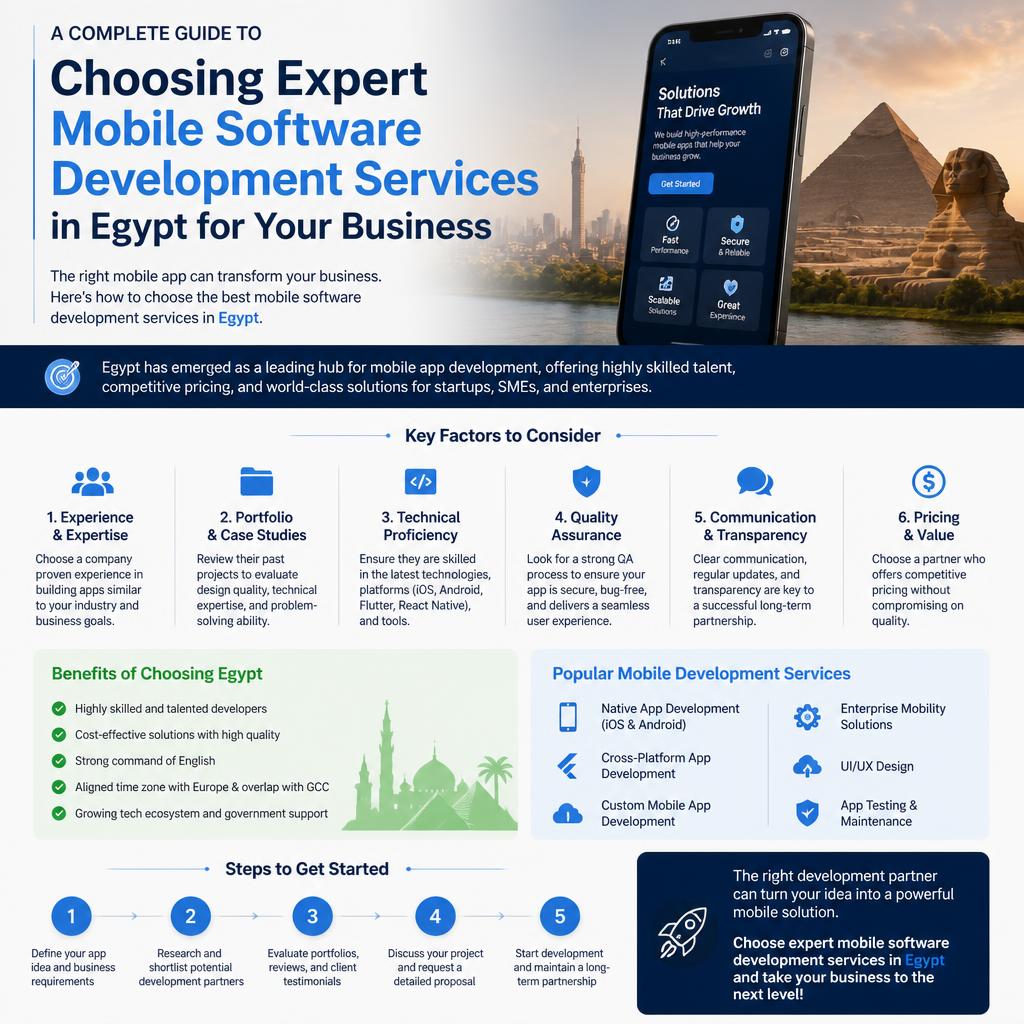
For organizations evaluating Expert Mobile Software Development Services in Egypt, the
challenge is not simply finding developers who can write code. A reliable development partner
should understand business objectives, user expectations, security requirements, technical
architecture, and long-term product growth.
This guide explains what Egyptian businesses should consider before selecting a development
company and how to identify a partner capable of turning an app concept into a practical digital
product.
What Are Expert Mobile Software Development Services?
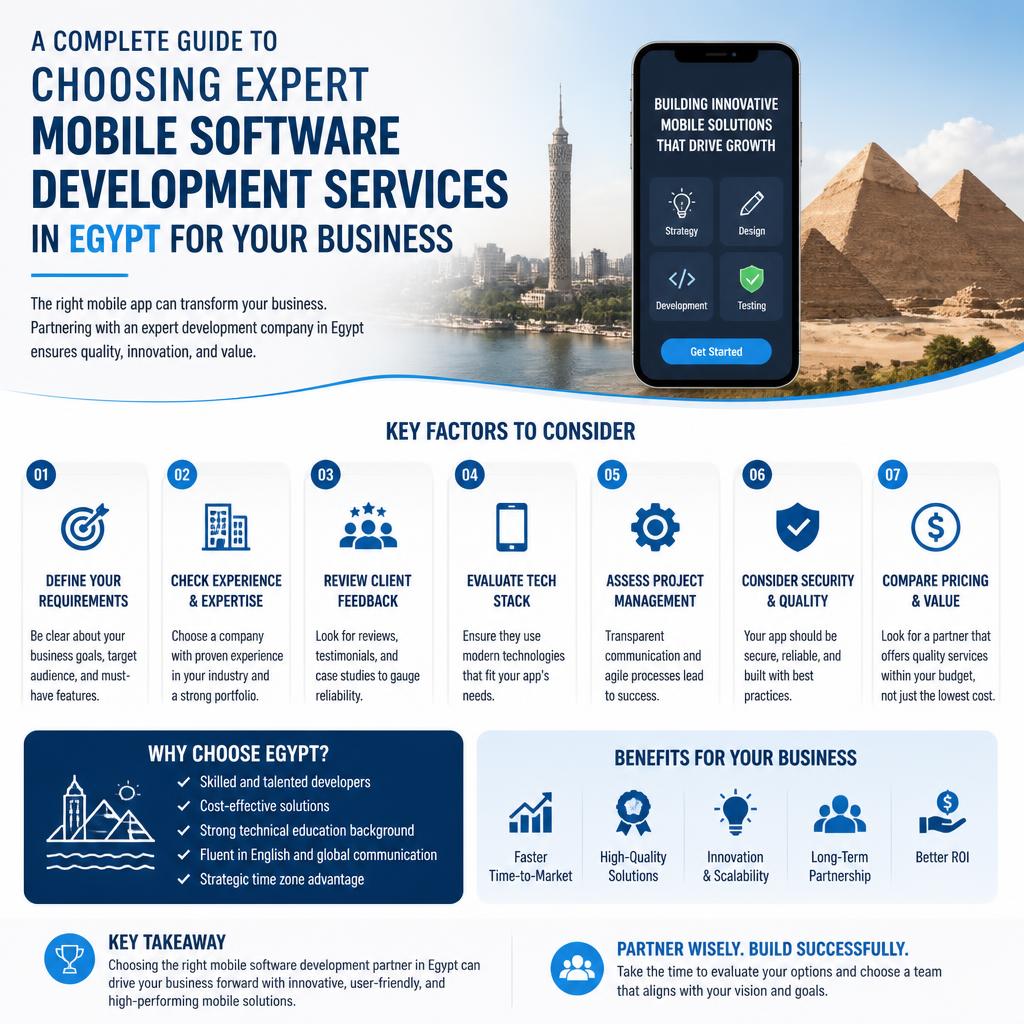
Mobile Software Development Services Egypt cover the complete process of planning,
designing, developing, testing, launching, and maintaining applications for smartphones and
tablets.
Professional development teams can create applications for different business requirements,
including:
- Customer-facing mobile applications
- Employee and internal business apps
- E-commerce applications
- Booking and appointment platforms
- Delivery and logistics applications
- Financial and payment solutions
- Educational applications
- Healthcare platforms
- On-demand service apps
- Enterprise mobility solutions
The strongest development projects begin with business requirements rather than technology
selection. Instead of choosing a framework first, businesses should identify the problem they
want the application to solve and then select technologies that support those objectives.
Why Choosing the Right Development Partner Matters
An application represents more than a digital interface. It can become a major customer
touchpoint and an important part of internal operations.
A poorly planned application may experience slow performance, confusing navigation, security
weaknesses, compatibility problems, or expensive maintenance requirements. These issues
can affect customer satisfaction and increase development costs later.
Working with an experienced Mobile App Development Company in Egypt can help
businesses establish a clearer development roadmap from the beginning.
The right partner can help with:
- Business and technical requirement analysis
- Product planning
- UI/UX design
- Mobile application development
- Backend development
- API integration
- Database architecture
- Quality assurance
- Application deployment
- Performance optimization
- Security implementation
- Post-launch maintenance
This full-cycle approach reduces the risk of treating mobile development as an isolated coding
project.
Start With Your Business Objectives
Before contacting development companies, define what you want the application to accomplish.
For example, an Egyptian retailer may want to increase online orders, while a logistics company
may need better delivery coordination. A healthcare organization might require appointment
scheduling, whereas an educational business may need mobile access to courses and learning
materials.
Write down the primary purpose of the application and identify measurable outcomes.
Ask questions such as:
- What business problem will the application address?
- Who will use it?
- What actions should users complete?
- Which existing systems need to connect with the app?
- What features are essential for the first release?
- What functionality can be introduced later?
- How will success be measured?
Clear answers allow developers to estimate the project more accurately and recommend an
appropriate technical strategy.
Evaluate Experience Beyond a Portfolio
A development portfolio can demonstrate what a company has built, but it does not tell the
entire story.
When comparing providers of Expert Mobile Software Development Services Egypt,
investigate whether their previous projects demonstrate relevant technical and business
experience.
Look for experience with:
- Similar industries
- Comparable user volumes
- Complex integrations
- Multi-role applications
- Payment systems
- Location-based functionality
- Real-time communication
- Enterprise applications
- Cloud infrastructure
- Data-intensive applications
A visually attractive portfolio is useful, but businesses should also understand how those
applications were engineered and maintained.
Ask potential developers what challenges they encountered in previous projects and how those
challenges were solved. Their answers can reveal much more about their capabilities than
screenshots alone.
Examine Their Mobile Development Technologies
Technology choices should support the application’s requirements rather than simply follow
current trends.
Depending on the project, businesses may consider native or cross-platform development.
Native Application Development
Native development involves building applications specifically for operating systems such as
Android or iOS.
It can be appropriate when an application requires:
- Advanced device capabilities
- High-performance functionality
- Platform-specific experiences
- Extensive hardware integration
- Complex animations or processing
Businesses looking for Android App Development Egypt or iOS App Development Egypt
should ask whether the development team has experienced specialists for their chosen
platform.
Cross-Platform Development
Cross-platform technologies can allow businesses to develop applications for multiple operating
systems from a shared codebase.
Frameworks such as Flutter and React Native are commonly considered for projects where
development efficiency and consistent functionality across platforms are important.
For businesses exploring Flutter App Development Services in Egypt, the development
partner should be able to explain where Flutter is appropriate and where native implementation
may be more suitable.
Similarly, organizations considering React Native Development Services in Egypt should
evaluate the team’s experience with performance optimization, native integrations, APIs, and
production deployment.
The best technology decision depends on the application’s functionality, budget, timeline,
expected growth, and maintenance requirements.
Pay Attention to UI/UX Capabilities
An application can have excellent backend technology and still fail to satisfy users if its interface
is difficult to navigate.
During the selection process, examine how the company approaches user experience.
A professional UI/UX process should consider:
- User journeys
- Navigation structure
- Screen hierarchy
- Accessibility
- Mobile usability
- Visual consistency
- Error handling
- Loading states
- Different device sizes
For Egyptian businesses serving diverse audiences, language and localization can also matter.
Applications may need Arabic interfaces, English interfaces, or a bilingual experience
depending on their target users.
A good development company should consider these requirements during the design stage
rather than treating localization as an afterthought.
Check Backend and Integration Expertise
Modern applications rarely operate independently.
A mobile app may need to communicate with websites, CRM platforms, ERP systems, payment
gateways, inventory software, logistics platforms, authentication services, analytics tools, and
third-party APIs.
This makes backend expertise an important part of Mobile Application Development Egypt
projects.
Ask prospective developers about their experience with:
- REST and other APIs
- Cloud services
- Database systems
- Authentication
- Third-party integrations
- Payment gateways
- Push notifications
- Real-time data
- Admin dashboards
- Analytics systems
A well-designed backend can make future upgrades easier and prevent the mobile application
from becoming dependent on a fragile technical foundation.
Security Should Be a Core Requirement
Security should never be added only after an application has been developed.
Applications may process customer information, business records, payment information,
credentials, location information, or other sensitive data. Developers should therefore consider
security throughout the architecture and development lifecycle.
When evaluating Custom Mobile App Development Egypt providers, ask how they handle:
- Secure authentication
- Authorization
- Data encryption
- API protection
- Secure storage
- Session management
- Input validation
- Dependency management
- Security testing
- Data access controls
Businesses should also understand how security updates will be handled after launch.
A development partner that treats security as an ongoing responsibility is generally better
positioned to support a long-term mobile product.
Understand the Development Process
A transparent process makes collaboration easier.
Before signing a contract, ask the development company to explain its workflow.
A typical process may include:
1. Discovery
The team studies business objectives, users, competitors, requirements, and technical
constraints.
2. Planning
Features, milestones, technology requirements, resources, and priorities are defined.
3. UX and UI Design
User journeys, wireframes, prototypes, and visual interfaces are created.
4. Development
Developers build the application, backend services, APIs, integrations, and supporting systems.
5. Testing
The application is tested for functionality, compatibility, usability, security, and performance.
6. Deployment
The completed product is prepared for the relevant app stores and production infrastructure.
7. Maintenance
After launch, the team handles improvements, bug fixes, compatibility updates, monitoring, and
future functionality.
A clearly defined process gives businesses better visibility into progress and responsibilities.
Ask How They Handle Scalability
An application that works for 1,000 users may require significant architectural changes when the
audience reaches hundreds of thousands.
Businesses should therefore discuss scalability before development begins.
A scalable solution may involve:
- Flexible backend architecture
- Efficient database design
- Cloud infrastructure
- API optimization
- Caching
- Modular application components
- Load management
- Monitoring and analytics
Companies seeking Custom Software Development Egypt should also consider whether the
application can eventually connect with additional business systems.
Scalability is not only about handling more users. It also means making it easier to introduce
new features without rebuilding the entire application.
Compare Pricing Carefully
Cost is naturally an important factor when selecting a development company, but the lowest
quotation may not provide the best overall value.
Two providers can quote different prices for the same project because their proposals may differ
in:
- Development methodology
- Technology choices
- Team experience
- Testing coverage
- UI/UX quality
- Security practices
- Infrastructure
- Project management
- Maintenance
- Post-launch support
Instead of asking only, “How much will the app cost?”, businesses should ask what is included
in the quotation.
A detailed proposal should explain the scope, deliverables, milestones, assumptions,
integrations, testing, deployment, and support arrangements.
This makes comparisons between providers more meaningful.
Confirm Post-Launch Support
Launching the application is only the beginning of its lifecycle.
Operating systems change, devices evolve, third-party services are updated, and customers
continuously request improvements.
Reliable Mobile App Maintenance Egypt services can help businesses manage these
changes.
Post-launch support may include:
- Bug resolution
- Performance monitoring
- Security updates
- Operating system compatibility
- Feature enhancements
- API updates
- Database maintenance
- App store updates
Before selecting a development partner, determine whether maintenance is included in the
project or offered through a separate support agreement.
Look for Strong Communication
Technical expertise is important, but communication can strongly influence the success of a
development project.
A development partner should make it easy for business stakeholders to understand:
- What has been completed
- What is currently being developed
- What decisions are required
- What risks exist
- Whether the timeline has changed
- How new requirements affect the budget
Regular meetings, progress reports, project management systems, and clear documentation
can keep both sides aligned.
For complex Enterprise Mobile App Development in Egypt, structured communication
becomes especially important because multiple departments and stakeholders may participate
in the project.
Consider Future Feature Expansion
Your first application release should not necessarily contain every possible feature.
A better approach can be to identify the core functionality needed for launch and create a
roadmap for future improvements.
For example, an initial business application might provide:
- Account creation
- Product or service browsing
- Search
- Orders or bookings
- Payments
- Notifications
Later releases could introduce loyalty programs, personalized recommendations, advanced
analytics, AI features, or deeper integrations.
This approach allows businesses to validate the product while keeping the initial development
scope manageable.
Questions to Ask Before Hiring a Development Company
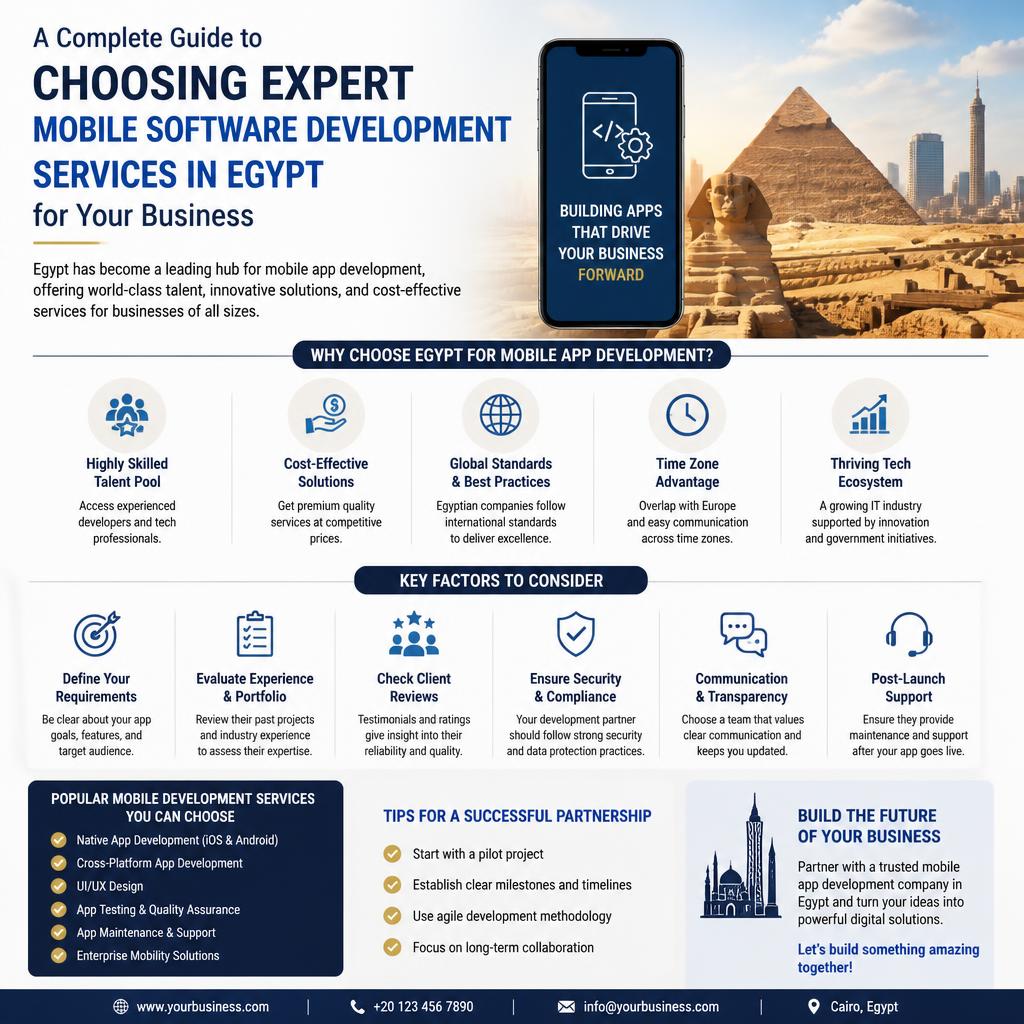
Before making the final decision, Egyptian businesses can ask potential development partners:
- 1.Have you developed applications similar to ours?
- Which technology would you recommend and why?
- Who will work directly on our project?
- How will requirements and changes be managed?
- How do you test mobile applications?
- How will the application be secured?
- Can the architecture support future growth?
- What third-party integrations can you handle?
- What is included in the development quotation?
- What support will be available after launch?
The answers can help distinguish between a company simply offering development capacity
and a partner capable of understanding the complete business requirement.
How to Select the Right Mobile Development Partner in
Egypt
After comparing potential companies, create a simple evaluation framework.
Consider each provider based on:
Technical capability: Can the team build the required functionality?
Industry understanding: Do they understand the challenges of your market?
Communication: Can they explain technical decisions clearly?
Development methodology: Is there a structured process for planning, testing, and delivery?
Scalability: Can the proposed architecture support future growth?
Security: Are security considerations incorporated throughout development?
Support: Will the team remain available after launch?
Value: Does the proposal provide appropriate quality for the investment?
This approach helps businesses make decisions based on overall value rather than price alone.
Why Egyptian Businesses Should Take a Long-Term
Approach
Mobile applications can become important components of a company’s digital infrastructure.
They may support customer acquisition, sales, employee productivity, communication,
operations, or service delivery.
That is why choosing Mobile Software Development Services Egypt should be viewed as a
long-term technology decision.
A development company should not only be capable of delivering the first version but should
also understand how the application can evolve as business requirements change.
For startups, this may mean creating a focused MVP that can be expanded after market
validation. For established organizations, it may involve integrating the application with existing
enterprise systems and creating a scalable architecture.
Final Thoughts
Selecting the right provider of Expert Mobile Software Development Services in Egypt
requires more than comparing portfolios and quotations. Businesses should evaluate technical
expertise, development methodology, security, scalability, communication, UI/UX capabilities,
integrations, and long-term support.
The right Mobile App Development Company in Egypt can help transform a business
requirement into a reliable mobile product while creating a technical foundation for future
growth.
Whether the project involves Custom Mobile App Development in Egypt, enterprise mobility,
Android and iOS applications, or cross-platform development, careful partner selection can
reduce risks and improve the application’s long-term value.
The goal should not simply be to launch an application. It should be to build a mobile solution
that serves users effectively, supports business objectives, and remains adaptable as the
Egyptian digital market continues to evolve.
Frequently Asked Questions
What should businesses consider when choosing mobile software
development services in Egypt?
Businesses should evaluate technical experience, relevant project expertise, UI/UX capabilities,
security practices, development methodology, scalability, communication, pricing transparency,
and post-launch support.
How much does custom mobile app development cost in Egypt?
The cost depends on factors such as application complexity, number of platforms, features,
integrations, design requirements, backend architecture, security needs, and ongoing
maintenance. A detailed project specification is normally required for a reliable estimate.
Should an Egyptian business choose native or cross-platform
development?
There is no universal answer. Native development can be useful for highly platform-specific or
performance-intensive applications, while cross-platform development can be efficient when
businesses need consistent functionality across Android and iOS.
Why is scalability important for a mobile application?
Scalability allows an application to accommodate increasing users, transactions, data, and
functionality without requiring a complete technical rebuild.
Is post-launch mobile app maintenance necessary?
Yes. Operating systems, devices, APIs, security requirements, and user expectations change
over time. Ongoing maintenance helps keep an application secure, compatible, and reliable.
How can businesses find reliable mobile app developers in Egypt?
Businesses should compare relevant experience, technical capabilities, development
processes, client references, communication practices, security standards, pricing, and long-
term support before selecting a development partner.