
A mobile application can begin as a simple idea and eventually become an important part of a
company’s entire digital ecosystem. A startup may initially need only a few core features, while
an established enterprise may require multiple user roles, complex integrations, advanced
security, analytics, and connections with existing business systems.
The challenge is making sure the application can evolve without becoming difficult or expensive
to maintain.
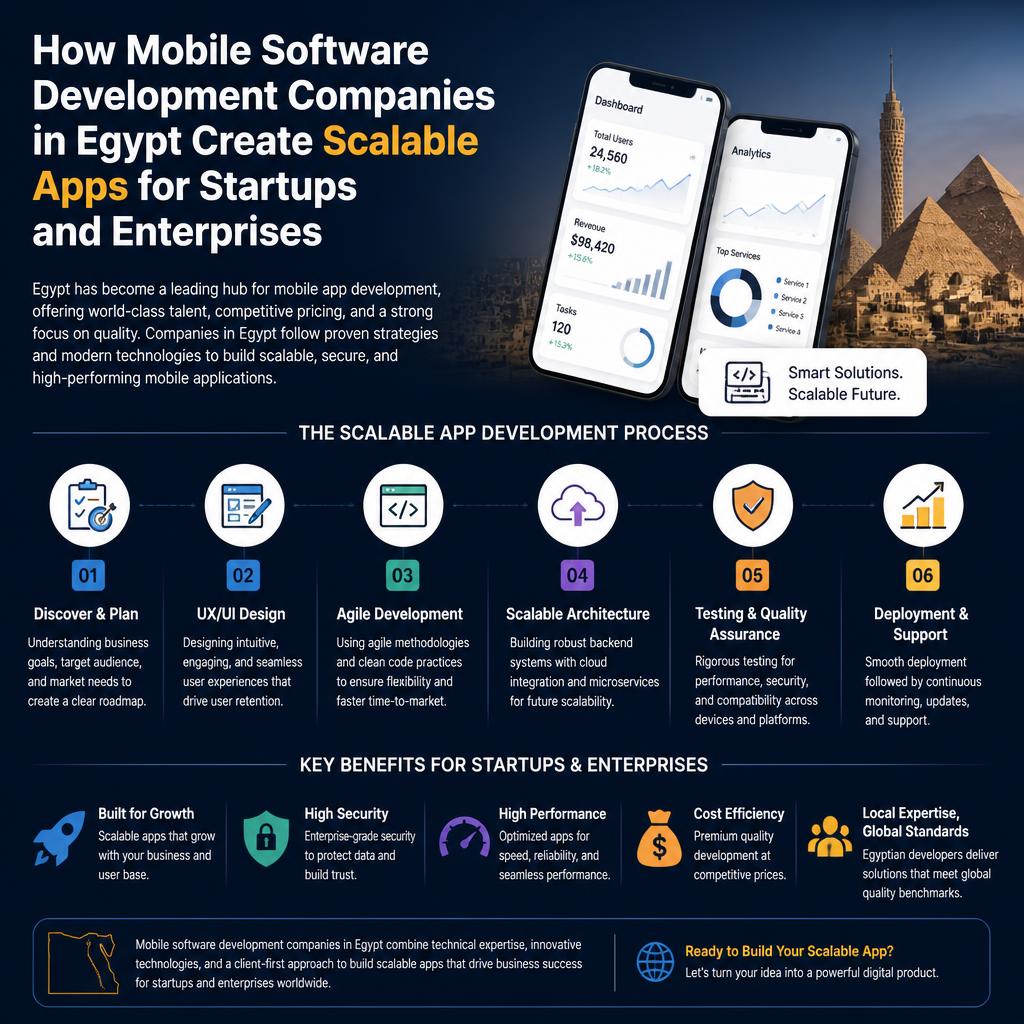
This is where mobile software development companies in Egypt can provide valuable
technical expertise. By combining product planning, modern development practices, cloud
technologies, scalable architecture, quality assurance, and ongoing support, development
teams can create applications designed to accommodate changing business requirements.
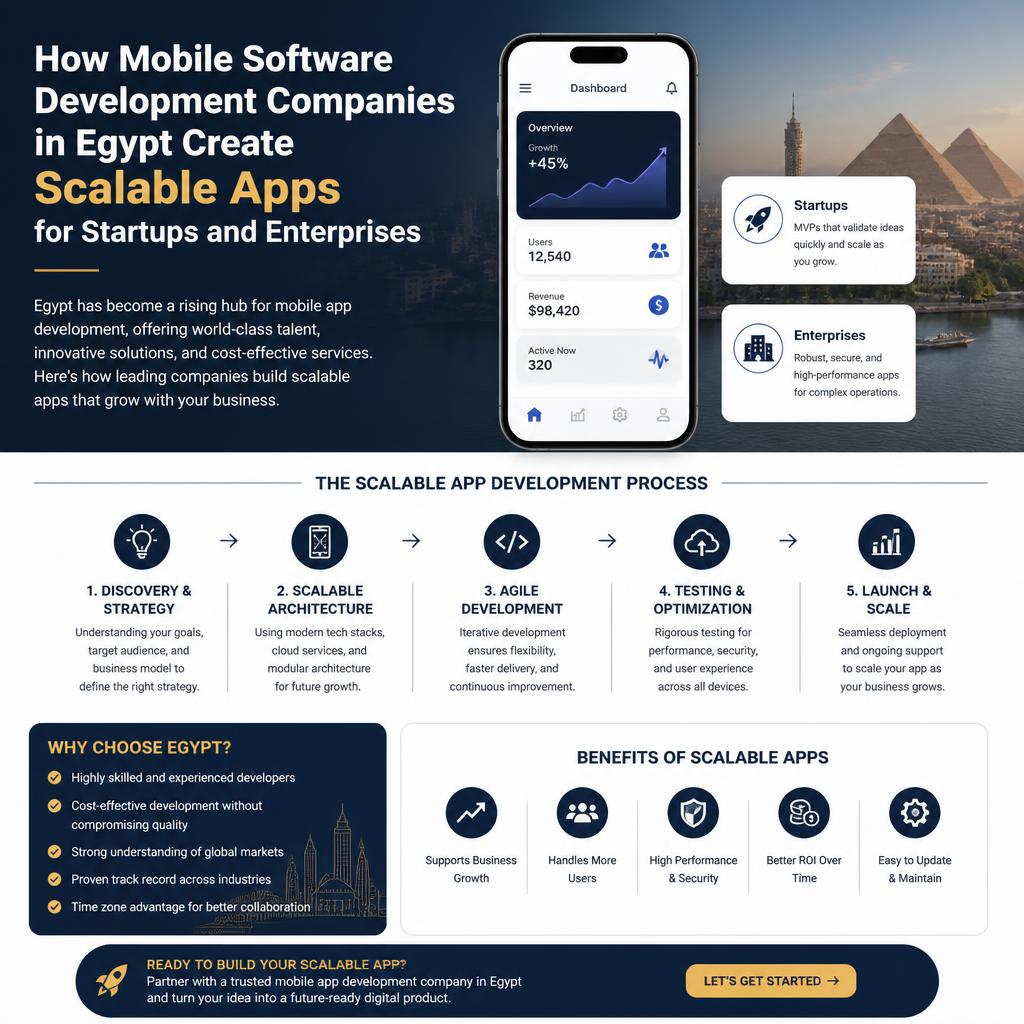
For startups, scalability can mean having a technical foundation that supports rapid user growth.
For enterprises, it can mean creating a dependable mobile platform that connects employees,
customers, partners, and internal systems.
In both situations, the goal is not simply to build an application that works today. The goal is to
create software that remains useful as the organization develops.
What Does a Scalable Mobile Application Mean?
A scalable mobile application is designed to handle increasing demand while maintaining
acceptable performance, reliability, and usability.
Growth can happen in several ways.
A company may experience:
- More application users
- More transactions
- Larger databases
- Additional geographic markets
- New product categories
- More employees
- Additional integrations
- New application features
A system that performs well with a small audience may struggle when demand increases if its
architecture was not designed appropriately.
Scalability therefore needs to be considered during the planning stage rather than treated as a
problem to solve after the application becomes successful.
Professional mobile software development services Egypt can help businesses determine
what level of scalability is appropriate for their expected growth and budget.
Why Do Startups Need Scalable Mobile Apps?
Startups operate under different conditions from established enterprises.
They often have limited budgets, uncertain market demand, and a need to validate their product
quickly.
However, building a basic MVP does not mean ignoring future development.
A startup may begin with a relatively small user base and later experience rapid adoption. If the
original architecture cannot accommodate that growth, the company may have to spend
significant resources rebuilding important parts of the application.
A better strategy is to create a focused first version using an architecture that allows reasonable
expansion.
For example, a startup developing a marketplace application might launch with:
- User registration
- Seller profiles
- Product listings
- Search
- Shopping cart
- Checkout
- Basic order management
After the business gains traction, it could add recommendations, loyalty features, advanced
seller analytics, promotional tools, and automated communication.
The initial architecture should make these additions manageable.
Why Do Enterprises Require a Different Scalability
Strategy?
Large organizations often have more complicated requirements.
An enterprise application may need to support different departments, locations, permissions,
workflows, and software systems.
For example, a large organization could require separate access levels for:
- Customers
- Employees
- Supervisors
- Managers
- Administrators
- External partners
Each group may see different information and perform different actions.
This makes enterprise mobile app development Egypt more complex than simply creating a
larger version of a consumer application.
Enterprise applications may also need integration with ERP platforms, CRM systems,
databases, identity-management tools, analytics systems, and other corporate software.
The development architecture therefore needs to account for organizational complexity as well
as user growth.
How Do Development Companies Plan for Scalability?
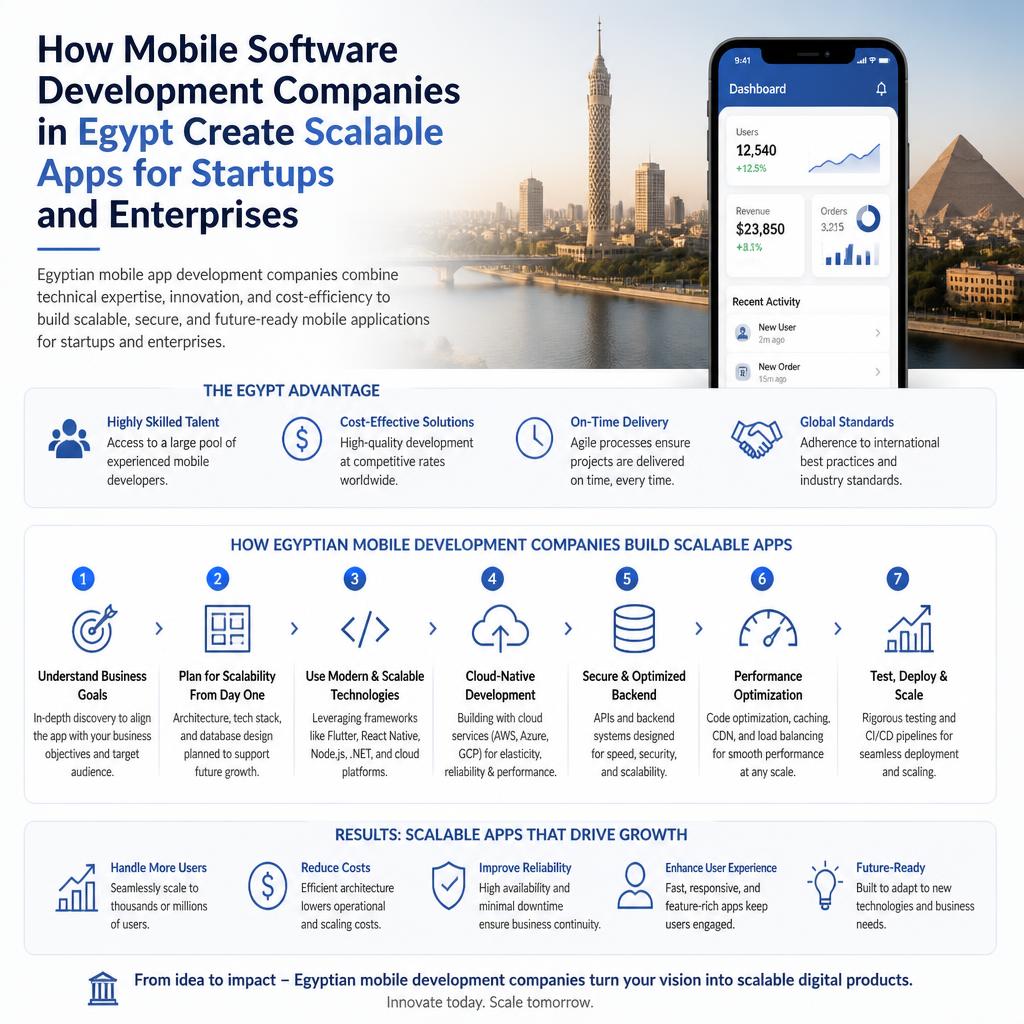
Scalability starts with understanding the business.
Before writing significant amounts of code, a professional development team should consider:
- Who will use the application?
- How many users are expected initially?
- What growth is realistic?
- What types of transactions will occur?
- What data will be stored?
- Which external systems need integration?
- Which features may be introduced later?
- What performance level is required?
- What security controls are necessary?
- What infrastructure will support the application?
The answers help developers select an appropriate architecture.
This planning process prevents businesses from paying for unnecessary infrastructure while still
giving the application a practical path for growth.
The Role of Backend Architecture in Scalable
Applications
A mobile application may appear simple from the user’s perspective, but the backend can be
significantly more complex.
The backend may manage:
- User accounts
- Authentication
- Permissions
- Business rules
- Transactions
- Databases
- Notifications
- Files
- Analytics
- APIs
- Third-party services
If the backend is poorly designed, increasing traffic can create performance problems even
when the mobile interface itself is well developed.
A scalable backend should therefore be designed around expected workloads.
Developers may use modular services, optimized databases, efficient APIs, caching, cloud
infrastructure, monitoring, and other engineering techniques depending on the project’s needs.
Why Are APIs Important for Business Applications?
APIs allow different software systems to exchange information.
Consider an e-commerce company.
Its mobile application may need information from:
Mobile App → API → Product Database
At checkout, additional systems may be involved:
Mobile App → API → Order System → Payment Service → Inventory System
A logistics application may similarly communicate with maps, driver-management software,
customer databases, and notification services.
Well-designed APIs make these connections easier to manage and expand.
Businesses evaluating a mobile app development company in Egypt should therefore ask
about API development and integration capabilities rather than focusing only on mobile interface
design.
How Does Cloud Technology Support Scalability?
Cloud infrastructure can provide businesses with flexible computing and storage resources.
Instead of relying entirely on fixed physical infrastructure, organizations can adjust resources
according to their requirements.
For a growing application, cloud technologies can support areas such as:
- Application hosting
- Database services
- File storage
- Traffic management
- Monitoring
- Backup
- Content delivery
- Automated deployment
The appropriate cloud architecture depends on the application’s requirements.
A small startup does not necessarily need a highly complex cloud environment from the first
day. An enterprise serving a large user base may require a more sophisticated infrastructure
strategy.
The important point is to choose infrastructure that matches actual business requirements and
future growth expectations.
How Can Developers Prevent Mobile Apps From
Becoming Slow?
Performance problems can damage user experience.
Users may abandon an application if pages take too long to load, interactions feel delayed, or
important functionality repeatedly fails.
Performance can be affected by:
- Large images
- Inefficient API requests
- Poor database queries
- Excessive background processing
- Network dependency
- Memory usage
- Complex application logic
- Poorly optimized code
Professional development teams can identify potential bottlenecks through profiling and
performance testing.
Optimization may include reducing unnecessary network requests, improving API responses,
optimizing assets, caching frequently used information, and improving backend queries.
Performance should be measured rather than assumed.
What Role Does Database Design Play in Scalability?
The database is one of the most important components of a scalable application.
As the number of users and transactions grows, inefficient database structures can become a
major performance limitation.
Developers need to consider:
- Data relationships
- Query efficiency
- Indexing
- Data volume
- Backup requirements
- Data consistency
- Access patterns
- Growth projections
A database designed for a few thousand records may behave differently when it contains
millions.
Good database architecture provides a foundation for future expansion without unnecessarily
complicating the initial application.
How Can Modular Development Help Startups and
Enterprises?
Modular architecture divides an application into logical components.
For example, an application could have separate modules for:
- Authentication
- User profiles
- Payments
- Notifications
- Orders
- Reporting
- Administration
This structure can make it easier to modify or extend individual areas without affecting the entire
system.
For startups, modularity can support gradual product expansion.
For enterprises, it can make large applications easier to manage across different teams and
departments.
The exact architecture depends on the application’s size and technical requirements, but
modular thinking can improve long-term maintainability.
Should Startups Build an MVP Before a Full Application?
In many situations, yes.
A startup may have a long list of ideas but limited evidence about what customers actually want.
An MVP allows the company to test its core proposition with a focused product.
However, an MVP should be strategically limited rather than poorly engineered.
The development team can identify:
Must-have features → Useful future features → Experimental features
The first release focuses on the first category.
After launch, customer feedback and usage data can guide the next development cycle.
This approach can reduce wasted development effort while allowing the product to evolve
based on real-world evidence.
How Do Flutter and React Native Support Cross-Platform
Development?
Businesses often want applications for both Android and iOS.
Developing two completely separate applications can require additional resources. Cross-
platform technologies provide another approach.
Flutter Development
Flutter app development in Egypt can help businesses create applications for multiple
platforms using a shared development framework.
This approach can be useful for organizations that want:
- Consistent user interfaces
- Shared development resources
- Efficient feature development
- Android and iOS support
- A streamlined maintenance strategy
Flutter may be appropriate for startups and businesses that value a unified cross-platform
development approach.
React Native Development
React Native app development in Egypt can also be considered when businesses want to
support multiple mobile platforms with a shared codebase.
It can be suitable for various applications, including:
- Customer platforms
- Marketplace applications
- Business tools
- Service applications
- MVPs
The choice between Flutter, React Native, and native development should be based on project
requirements rather than popularity alone.
Why Is UI Architecture Important for Growing Apps?
Scalability is not only a backend concern.
The user interface also needs to accommodate additional functionality without becoming
confusing.
Imagine an application that begins with five screens and eventually grows to fifty.
If navigation was not designed with expansion in mind, users may struggle to find important
features.
A scalable UI strategy considers:
- Navigation patterns
- Information hierarchy
- Reusable components
- User roles
- Feature grouping
- Accessibility
- Localization
- Future functionality
Reusable design components can also help maintain visual consistency as the application
expands.
How Can Arabic Localization Improve Mobile Experiences
in Egypt?
Businesses targeting Egyptian audiences may need applications that support Arabic users
naturally.
Arabic localization involves more than translating words.
The application may need:
- Right-to-left layouts
- Arabic typography
- Appropriate text alignment
- RTL navigation
- Localized dates and numbers
- Proper form layouts
- Bilingual content management
If Arabic and English are both required, the underlying interface should be designed to
accommodate both languages from the beginning.
Trying to add RTL support after the application has been completed can create unnecessary
redesign work.
How Do Scalable Apps Handle Different User Roles?
Many business applications serve multiple types of users.
For example, a delivery platform may include:
Customer → Driver → Dispatcher → Manager → Administrator
Each role may require different capabilities.
A customer should not have access to administrative functions.
A driver may need delivery information but not financial reports.
A manager may require operational dashboards.
Role-based access controls can help separate these permissions.
This becomes especially important in enterprise mobile app development in Egypt, where
applications may be used across departments and organizational levels.
What Security Measures Should Scalable Apps Include?
A growing application can become a larger target for security threats.
Security should therefore be integrated into the architecture from the beginning.
Depending on the application, development teams may implement:
- Secure authentication
- Role-based authorization
- Protected APIs
- Encryption
- Secure session handling
- Input validation
- Access controls
- Secure storage
- Logging
- Security testing
As the application grows, security requirements may also become more complex.
Regular updates and monitoring can help organizations respond to new vulnerabilities and
changes in the technology environment.
How Does Automated Testing Help Growing
Applications?
As applications gain features, manual testing becomes increasingly difficult.
A change to one feature can unintentionally affect another.
Automated testing can help developers verify important functionality consistently.
Testing strategies may include:
Unit Testing
Checks individual components or functions.
Integration Testing
Verifies that different systems work together correctly.
UI Testing
Evaluates important user interactions.
API Testing
Checks communication between applications and backend services.
Performance Testing
Examines application behavior under different workloads.
Regression Testing
Ensures new changes have not broken existing functionality.
A strong testing strategy can reduce the risk associated with frequent application updates.
Why Is Monitoring Necessary After Launch?
Scalability cannot be confirmed simply by launching the application.
Real-world users can reveal problems that were not visible during development.
Monitoring can provide information about:
- Application errors
- API failures
- Server performance
- Response times
- Database activity
- Crash rates
- Traffic patterns
These insights can help development teams identify problems before they become major
disruptions.
For growing businesses, monitoring is particularly valuable because application usage can
change quickly.
What Should Businesses Expect From Mobile Software
Development Services?
A professional development engagement should provide more than coding.
Depending on the provider and project scope, mobile software development services Egypt
may include:
- Business analysis
- Technical consulting
- UI/UX design
- Mobile development
- Backend engineering
- API integration
- Cloud deployment
- Quality assurance
- Security testing
- App store deployment
- Maintenance
- Performance optimization
Businesses should confirm exactly which services are included in a proposal.
This prevents misunderstandings about responsibilities and project scope.
How Should Startups and Enterprises Select a
Development Partner?
The ideal development partner depends on the organization’s needs.
Startups should look for teams that can:
- Work within realistic budgets
- Prioritize MVP functionality
- Move efficiently
- Provide strategic technical guidance
- Build an expandable foundation
Enterprises may need teams capable of:
- Complex integrations
- Large-scale architecture
- Advanced security
- Multiple user roles
- Corporate software integration
- Long-term maintenance
- Large development teams
A company may therefore be an excellent fit for one type of organization but not another.
The selection should be based on actual project requirements.
What Questions Should Businesses Ask Development
Companies?
Before starting a project, decision-makers can ask:
How will you design the application for future growth?
The provider should explain its approach to architecture, infrastructure, APIs, and databases.
How will you handle increased users?
Ask how performance and infrastructure can be adapted as traffic grows.
Which technology do you recommend?
The answer should include reasoning related to the specific application.
How will the application integrate with existing software?
This is especially important for enterprise projects.
How will security be implemented?
Ask about authentication, permissions, APIs, storage, and testing.
What happens after launch?
Clarify maintenance, updates, monitoring, and support.
How will new features be added?
The development process should support controlled product expansion.
How Can Businesses Keep Mobile App Development
Cost Under Control?
Scalability does not require unlimited spending.
One of the most effective strategies is prioritization.
Businesses should distinguish between essential functionality and optional features.
For example:
Initial Release
- Core user journey
- Essential account functionality
- Primary transaction
- Basic notifications
- Required administration
Later Releases
- Advanced analytics
- Personalization
- Loyalty programs
- Additional integrations
- Automation
- AI-based functionality
This phased approach allows companies to invest according to actual business performance.
Development costs can also be influenced by platform choice, design complexity, integrations,
security requirements, backend architecture, testing scope, and maintenance expectations.
A detailed technical scope is therefore more useful than relying on a generic development price.
What Is the Future of Scalable Mobile Applications?
Mobile applications are increasingly becoming connected components of broader digital
ecosystems.
Future-ready applications may interact with:
- Artificial intelligence
- Cloud platforms
- Business intelligence
- Automation systems
- IoT devices
- Location technologies
- Digital payment systems
- Enterprise software
For startups, this could create opportunities to introduce intelligent features after achieving
product-market validation.
For enterprises, it could allow mobile applications to become interfaces for larger digital
transformation initiatives.
The key is flexibility.
Businesses do not need to implement every emerging technology immediately. They need an
architecture that can accommodate relevant technologies when they create genuine business
value.
Frequently Asked Questions
What makes a mobile app scalable?
A scalable mobile application uses an architecture, backend, database, APIs, and infrastructure
capable of handling increasing users, data, transactions, and functionality without requiring a
complete rebuild.
Why should startups invest in scalable app development?
Startups benefit from a scalable foundation because successful products may experience rapid
user growth. A flexible architecture can make future expansion easier while allowing the first
version to remain focused.
What is enterprise mobile app development?
Enterprise mobile app development involves creating applications for organizational use, often
including multiple user roles, advanced security, internal workflows, corporate integrations,
analytics, and complex backend systems.
Are mobile software development companies in Egypt suitable for
startups?
Yes. Egyptian development teams can work with startups on MVPs, customer applications,
cross-platform products, backend systems, and future product expansion, depending on their
individual capabilities and experience.
Is Flutter good for scalable applications?
Flutter can be suitable for scalable applications when its architecture, backend systems, APIs,
and overall technical design are appropriate for the project’s requirements. Scalability depends
on the entire system rather than the framework alone.
Is React Native suitable for growing businesses?
React Native can be considered for growing businesses that need cross-platform mobile
applications. The suitability depends on performance requirements, integrations, platform-
specific functionality, and the project’s long-term technical strategy.
Can a scalable app support Arabic and English?
Yes. Applications can be designed to support Arabic and English, including appropriate right-to-
left behavior for Arabic interfaces. Bilingual requirements should ideally be considered during
the initial UX and architecture stages.
Do scalable mobile apps require cloud infrastructure?
Not necessarily in every case, but cloud infrastructure can provide useful flexibility for
applications that experience changing workloads or require scalable hosting, storage,
databases, monitoring, and deployment systems.
Final Thoughts
Building a mobile application that can grow requires careful decisions long before the first
version reaches users.
Startups need enough technical flexibility to expand after validating their ideas. Enterprises
need architecture capable of supporting complex workflows, multiple users, integrations,
security requirements, and organizational growth.
This is why choosing experienced mobile software development companies in Egypt can be
an important step for businesses planning serious mobile products.
The strongest development strategy combines business understanding with appropriate
technology. It considers backend architecture, APIs, databases, cloud infrastructure, user
experience, security, testing, monitoring, and maintenance as connected parts of one system.
A scalable application should not be unnecessarily complicated. It should simply be designed
with a realistic understanding of where the business is today and where it intends to go.
For Egyptian startups and enterprises, that balance can turn a mobile application from a short-
term digital project into a platform capable of supporting long-term business growth.