Want to Develop Apps
for your Business ?

An excellent service management in the area of IT providing solutions. High level efficient solution to businesses growth.

Mobile App and Logistics Management Software Company in Riyadh
Open

Monthly Archives: September 2026

Categories Blog

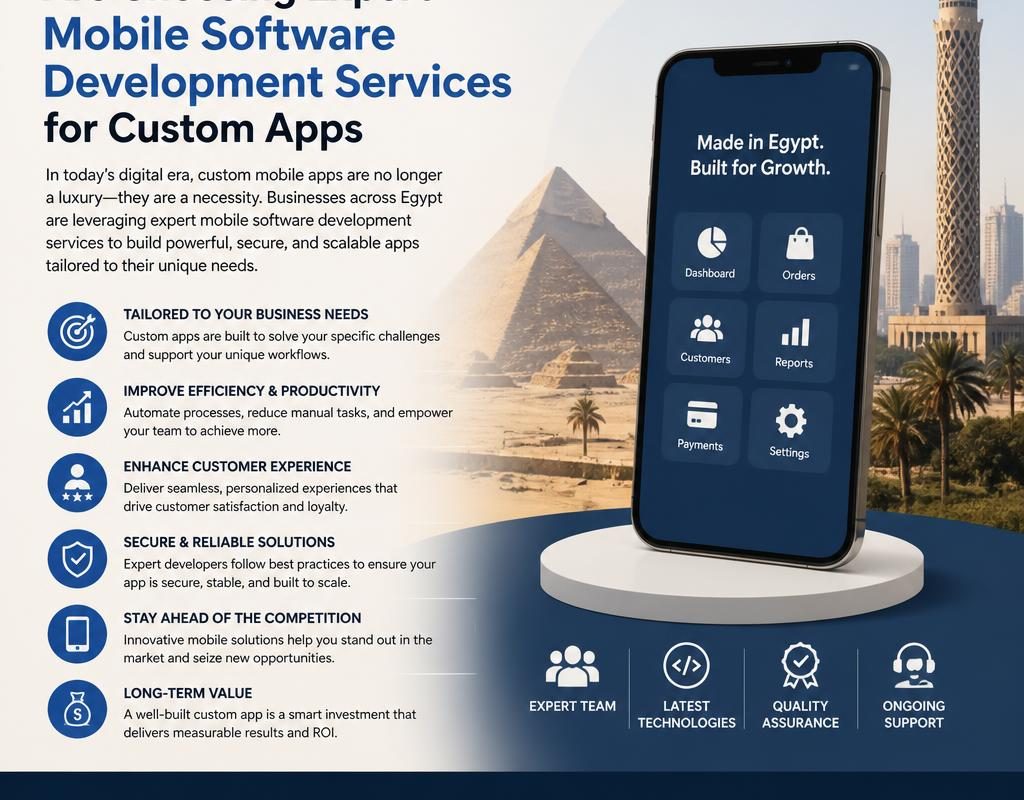
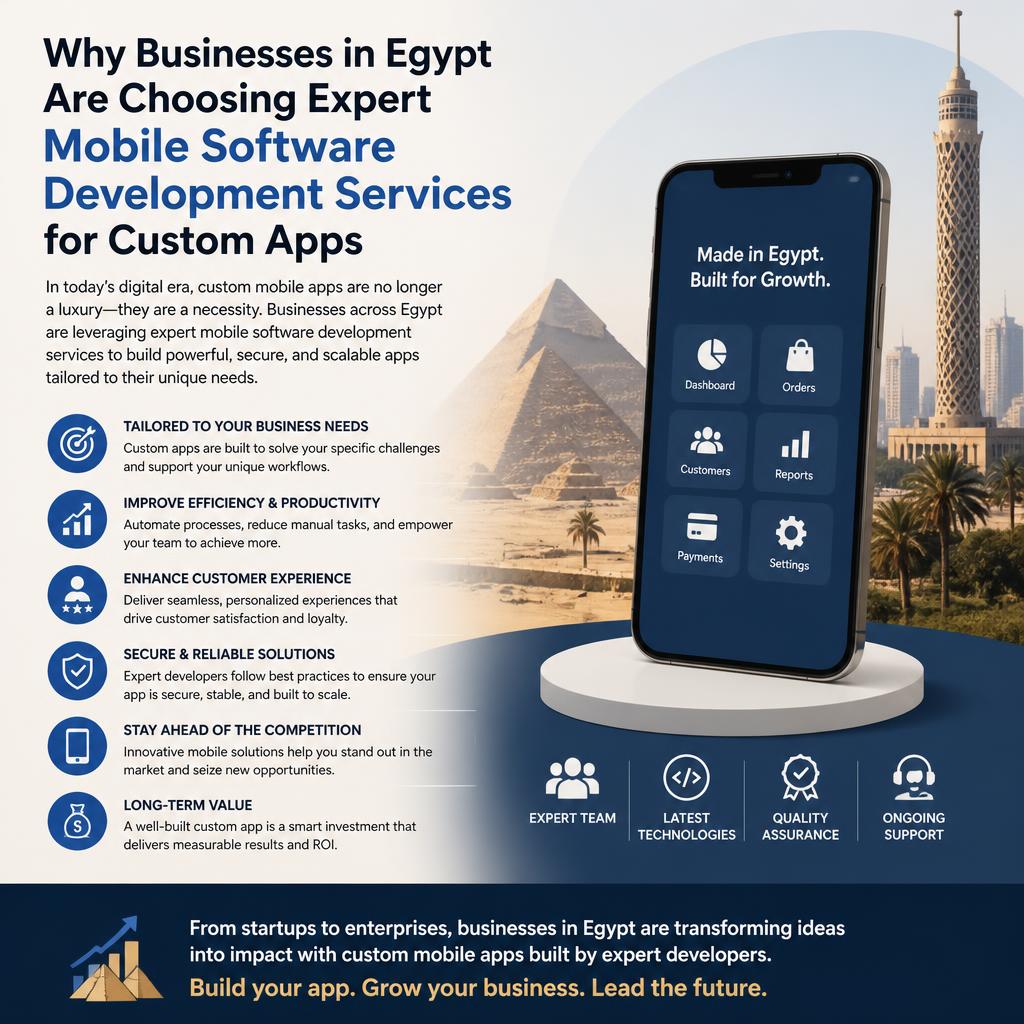
Why Businesses in Egypt Are Choosing Expert Mobile Software Development Services for Custom Apps

Egypt’s business environment is becoming increasingly digital, and mobile technology is playing
an important role in this transformation. Customers want faster services, simpler interactions,
instant information, and convenient ways to communicate with businesses. At the same time,
companies need technology that can support internal operations while giving customers a
reliable digital experience.

This shift is encouraging organizations to move beyond basic websites and generic software
platforms. Many are investing in applications designed specifically around their products,
services, workflows, and customers.

That is one of the key reasons demand for expert mobile software development services in
Egypt
continues to grow.

Custom applications give businesses the flexibility to create digital experiences that match their
individual requirements. Instead of forcing an organization to adjust its processes around
prebuilt software, a custom solution can be structured around the way the company actually
operates.

From emerging startups to established enterprises, businesses across Egypt can use
customized mobile applications to improve service delivery, simplify operations, strengthen
customer relationships, and create new digital opportunities.

Why Are Custom Mobile Apps Becoming Important for
Egyptian Businesses?
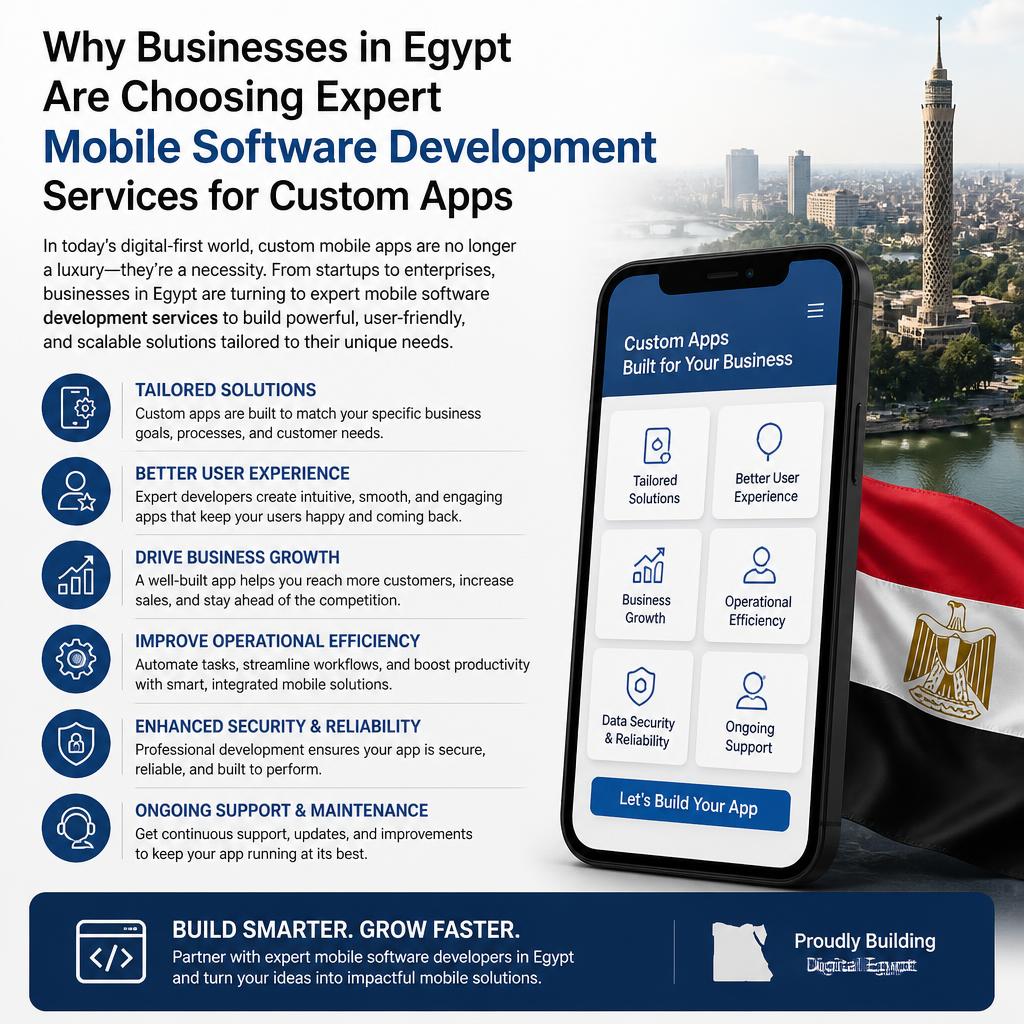
A business application is no longer simply a digital extension of a company website.

Modern applications can act as complete business platforms.

A customer may use an application to place an order, make a booking, request a service,
communicate with support, track an activity, or manage an account. Behind those actions, the
application can connect with databases, APIs, payment systems, administrative dashboards,
analytics platforms, and other business software.

This creates a connected digital environment.

For Egyptian businesses competing in increasingly digital markets, such capabilities can provide
practical advantages.

The important question is not whether every company needs an application.

Instead, businesses should ask:

Can a custom mobile application solve a meaningful customer or operational problem
better than existing alternatives?

When the answer is yes, professional development becomes a valuable investment.


What Makes Custom Mobile Applications Different?

Generic applications are designed to serve broad audiences. They usually provide a predefined
set of features that businesses can configure to a limited degree.

Custom software works differently.

With custom mobile app development in Egypt, the development process starts with the
organization’s specific objectives.

A company can determine:

● Which users will access the application
● Which actions users should perform
● What information should be displayed
● Which business rules should apply
● Which systems should be integrated
● What permissions different users should have
● Which reports management requires
● What features may be introduced later

This level of control can be particularly useful when a business has specialized workflows.

For example, a logistics company may need separate interfaces for customers, drivers,
dispatchers, and managers. A generic application may not provide the exact combination of
functionality required by all four groups.

A custom platform can.

How Can Mobile Applications Improve Customer
Experience?

Customers generally value convenience.

If a business makes it easier to complete an important task, the digital experience becomes
more useful.

A mobile application can bring frequently used services into one place.

Depending on the business model, customers may be able to:

  • Create accounts
  • Search for products or services
  • Make reservations
  • Place orders
  • Track requests
  • Receive notifications
  • Contact customer support
  • Manage subscriptions
  • Access personalized information
  • Review previous transactions

This reduces the need to move between different communication channels.

For businesses targeting Egyptian consumers, localized experiences can make applications
even more useful. Arabic and English interfaces can be designed around the preferences of
different customer groups, while local business workflows can be reflected in the application’s
functionality.

Why Are Businesses Moving Away From One-Size-Fits-
All Software?

Prebuilt software can be useful for straightforward requirements.

However, businesses can encounter limitations when their operations become more complex.

A company may need a feature that does not exist in the standard product. It may require a
specialized approval workflow, unusual reporting system, custom user roles, or integration with
internal software.

Adding workarounds to generic software can eventually create complexity.

Custom development avoids some of these limitations by designing the software around the
business from the beginning.

This does not mean every organization should immediately commission a large application.

The better approach is to identify the specific problem and determine whether customization
provides enough value to justify the investment.

How Can Expert Mobile Software Development Services
Support Business Growth?

Professional development teams can help businesses create applications that evolve with their
requirements.

The development process can begin with a limited set of high-priority features and expand over
time.

For example, an Egyptian retail company might initially launch an application with:

  • Product browsing
  • Customer accounts
  • Shopping cart
  • Checkout
  • Order tracking

After gathering customer feedback, the business could introduce:

  • Loyalty programs
  • Personalized recommendations
  • Push notifications
  • Subscription options
  • Advanced analytics

This incremental approach allows businesses to focus their initial resources on the most
valuable functionality.

A capable mobile app development company in Egypt can help define this roadmap and
determine which technical foundations should be established from the beginning.

Which Industries Can Benefit From Custom Mobile
Applications?

Custom mobile software can be adapted to many industries.

Retail and E-Commerce

Retailers can create applications that combine product discovery, purchasing, customer
accounts, promotions, delivery tracking, and loyalty features.

A customized platform can also connect with inventory and order-management systems.

Logistics and Transportation

Transportation businesses can use mobile applications to coordinate drivers, customers,
dispatch teams, and managers.

Possible functionality includes delivery assignments, location tracking, route information, status
updates, digital proof of delivery, and operational dashboards.

Healthcare

Healthcare organizations can use mobile applications to simplify appointment scheduling,
reminders, communication, service discovery, and other digital interactions.

Security and appropriate data handling are especially important for healthcare-related products.

Education

Educational institutions and learning companies can provide mobile access to courses,
assignments, educational resources, assessments, and communication tools.

Hospitality

Hotels, restaurants, and tourism companies can use applications for reservations, ordering,
service requests, loyalty programs, and customer communication.

Real Estate

Property businesses can provide searchable listings, property details, inquiry forms,
appointment scheduling, and communication with agents.

Financial Services

Financial applications require strong security and dependable infrastructure. Depending on the
product, businesses may offer account management, transactions, notifications, dashboards,
and support services.

Should Egyptian Businesses Choose Native or Cross-
Platform Development?

This is one of the most important technical decisions in a mobile application project.

Native development creates applications specifically for individual platforms.

Cross-platform development allows developers to share a substantial portion of the application
code between platforms.

Neither option is automatically superior.

Native development can make sense when an application requires deep platform-specific
capabilities, highly optimized performance, or specialized device functionality.

Cross-platform development can be attractive when a business wants to serve Android and iOS
audiences while maintaining a shared development approach.

Two commonly considered technologies are React Native and Flutter.

React Native for Custom Business Applications

React Native development services in Egypt can be considered by companies looking for
applications that support multiple mobile platforms while sharing much of their development
code.

The framework can be suitable for various business products, including customer applications,
service platforms, marketplace solutions, and startup MVPs.

However, the technology should always be evaluated against the project’s actual requirements.

Flutter for Cross-Platform Products

Flutter app development services in Egypt can provide another option for businesses that
want a cross-platform application.

Flutter allows development teams to create applications for multiple platforms using a shared
technology approach while maintaining control over the user interface.

It can be useful for companies that want to create a consistent experience across devices.

Again, the right choice depends on functionality, performance, integrations, development
resources, and future maintenance.

Why Is Integration Important for Custom Apps?

A mobile application often needs to communicate with other software.

For example, an e-commerce application might need to connect with an inventory system,
payment provider, CRM, shipping service, and analytics platform.

A logistics application could communicate with mapping services, fleet systems, customer
databases, notification services, and reporting platforms.

This is where APIs become important.

Well-designed APIs allow information to move between different systems.

When evaluating mobile software development services Egypt, businesses should therefore
ask potential providers about their experience with system integrations.

Important areas include:

  • API architecture
  • Authentication
  • Data synchronization
  • Third-party services
  • Error handling
  • Integration testing
  • Performance
  • Future compatibility

Planning integrations early can reduce technical complications later.

How Can Custom Apps Help Automate Business
Processes?

Automation can turn a mobile application into an operational tool rather than simply a customer
interface.

Consider a service business that receives customer requests manually.

An automated mobile workflow could look like:

Request received → Service assigned → Employee notified → Work started → Status updated →
Customer informed → Task completed

This can reduce repetitive communication and give management a clearer view of ongoing
activities.

Different businesses can automate different workflows.

Examples include:

  • Order processing
  • Employee task assignments
  • Appointment reminders
  • Delivery updates
  • Customer notifications
  • Approval processes
  • Inventory updates
  • Field-service reporting

Custom development allows these workflows to be tailored to the organization’s actual
procedures.

Why Does Scalability Matter?

A mobile application should not become a technical limitation as the business grows.

A small business may start with a limited number of customers and later expand into additional
cities, services, or market segments.

The underlying software should therefore be capable of handling increasing demand.

Scalability may involve:

  • Efficient database architecture
  • Modular software design
  • Cloud infrastructure
  • Optimized APIs
  • Caching
  • Performance monitoring
  • Load management
  • Expandable user-role systems

For enterprise mobile app development in Egypt, scalability becomes particularly important
because applications may serve multiple departments and large user groups.

The development team should understand the expected growth path before finalizing the
architecture.

How Important Is Application Security?

Custom applications can process valuable business and customer information.

Security should therefore be treated as a core engineering requirement.

Depending on the application’s purpose, developers may need to implement:

  • Secure authentication
  • Authorization controls
  • Protected APIs
  • Data encryption
  • Secure storage
  • Session management
  • Input validation
  • Role-based permissions
  • Security testing
  • Monitoring

Businesses should also establish who is responsible for security updates after launch.

A mobile application is exposed to an evolving technical environment, so ongoing maintenance
is important.

What Should Businesses Expect From the Development
Process?

A professional project should have a clear lifecycle.

Business Discovery

The team studies the business model, customers, workflows, competitors, and project
objectives.

Requirement Definition

Features and technical requirements are documented and prioritized.

Product Design

User journeys, wireframes, prototypes, and interface designs are developed.

Engineering

The mobile application, backend services, APIs, database systems, and integrations are
implemented.

Quality Assurance

The product is tested for functionality, compatibility, usability, performance, and security.

Deployment

The application is prepared for the appropriate distribution channels.

Continuous Improvement

After launch, the team can use user feedback, analytics, and business priorities to improve the
product.

This structured approach helps transform an idea into a controlled development project.

How Much Does Custom Mobile App Development Cost
in Egypt?

There is no universal development price because applications vary significantly in complexity.

The cost may depend on:

  • Number of platforms
  • Number of features
  • UI/UX complexity
  • Backend requirements
  • Third-party integrations
  • User roles
  • Payment systems
  • Real-time functionality
  • Security requirements
  • Testing scope
  • Cloud infrastructure
  • Maintenance requirements

A simple business application may require a very different budget from a complex enterprise
platform.

Instead of asking only for the lowest quote, businesses should request a detailed scope.

The proposal should explain what is included in development, testing, deployment,
documentation, support, and future maintenance.

Why Is Post-Launch Maintenance Necessary?

Publishing an application is not the final stage of its lifecycle.

Mobile operating systems receive regular updates. Devices change. Third-party services modify
their APIs. Users identify new issues. Businesses introduce new requirements.

Without maintenance, an application can gradually become outdated.

Ongoing support may involve:

  • Bug fixes
  • Performance optimization
  • Security updates
  • OS compatibility
  • Device compatibility
  • API updates
  • Feature enhancements
  • Technical monitoring

Businesses should discuss these responsibilities with their development partner before the
initial project is completed.

What Should Egyptian Businesses Ask Before Hiring a
Development Company?
Before selecting a provider, decision-makers should ask practical questions.

Does the company have relevant experience?

Look for projects that demonstrate experience with similar functionality or industries.

Can the team handle both mobile and backend development?

If the application requires a complete custom ecosystem, backend capabilities are essential.

How does the company approach security?

Ask how authentication, APIs, data storage, access control, and testing are handled.

What technologies does the team recommend?

The provider should explain why a particular technology is appropriate rather than simply
promoting its preferred framework.

How does testing work?

Understand how the application will be tested across supported devices and operating systems.

What happens after launch?

Clarify maintenance, bug fixing, updates, monitoring, and support.

How are project changes managed?

A transparent process for scope changes can prevent unexpected costs and delays.

Why Local Understanding Can Benefit Egyptian
Companies

Technical capability is the primary requirement, but knowledge of the target market can also
contribute to a better product.

A development team familiar with Egypt may understand practical considerations around Arabic
interfaces, local customer behavior, regional business processes, and the needs of
organizations operating within the Egyptian market.

For businesses targeting customers in Cairo, Alexandria, Giza, and other Egyptian locations,
this local context can help shape a more relevant product.

However, businesses should still evaluate a development provider based on the complete
combination of technical expertise, experience, portfolio quality, communication, security,
scalability, and support.

Frequently Asked Questions

Why are businesses in Egypt choosing custom mobile applications?

Businesses are choosing custom mobile applications because they can provide functionality
tailored to specific customer needs, internal workflows, integrations, and growth plans rather
than relying entirely on generic software.

What are expert mobile software development services in Egypt?

They include professional services for planning, designing, engineering, testing, deploying,
integrating, and maintaining mobile applications for businesses targeting Egyptian or
international users.

How do I choose a mobile app development company in Egypt?

Evaluate the provider’s relevant experience, technical expertise, portfolio, UI/UX capabilities,
backend skills, security practices, testing process, communication, pricing structure, and post-
launch support.

Is custom mobile app development suitable for startups?

Yes. Startups can begin with a focused MVP containing the most important functionality and
expand the product after validating the idea with real users.

Is Flutter suitable for Egyptian businesses?

Flutter can be suitable for businesses that need cross-platform mobile applications. Its suitability
should be evaluated according to the project’s functionality, integrations, performance
expectations, and long-term maintenance strategy.

Can React Native be used to create business applications?

Yes. React Native can be considered for many customer-facing and business applications,
particularly when organizations want a cross-platform development approach.

Can a custom app connect to an existing ERP or CRM?

Yes. Applications can connect to existing business platforms through APIs and other integration
methods when the relevant systems support appropriate integration capabilities.

Does a custom application need regular updates?

Yes. Regular maintenance helps address security concerns, operating-system changes,
compatibility issues, bugs, performance problems, and evolving business requirements.

The Growing Role of Mobile Software in Egypt

The next stage of mobile development will increasingly connect applications with other digital
technologies.

Cloud platforms, artificial intelligence, automation, analytics, location services, digital payments,
and business intelligence can extend what mobile applications are capable of delivering.

For Egyptian companies, this creates an opportunity to develop applications that actively
support business operations instead of simply presenting information.

A logistics company could connect mobile workflows with real-time operational data.

A retailer could combine customer behavior with personalized recommendations.

A service company could automate customer requests and employee assignments.

An educational platform could provide personalized learning experiences.

The possibilities depend on the business problem and the technology strategy behind the
product.

Final Thoughts

Businesses in Egypt are increasingly looking for digital solutions that can adapt to their
customers and internal processes.

Custom mobile applications can provide that flexibility when they are planned and engineered
correctly.

The strongest projects begin with a clear business objective rather than a list of fashionable
technologies. They identify the right users, prioritize valuable functionality, select an appropriate
development approach, plan integrations, protect important information, test thoroughly, and
establish a strategy for ongoing improvement.

For organizations considering expert mobile software development services in Egypt, the
goal should not simply be to launch another application.

The objective should be to create a useful digital product that solves a genuine problem,
provides a smooth experience, supports business operations, and remains capable of evolving
as the organization grows.

With the right development partner and a clearly defined product strategy, Egyptian businesses
can turn custom mobile software into a long-term digital asset rather than a short-lived
technology project.
Categories Blog

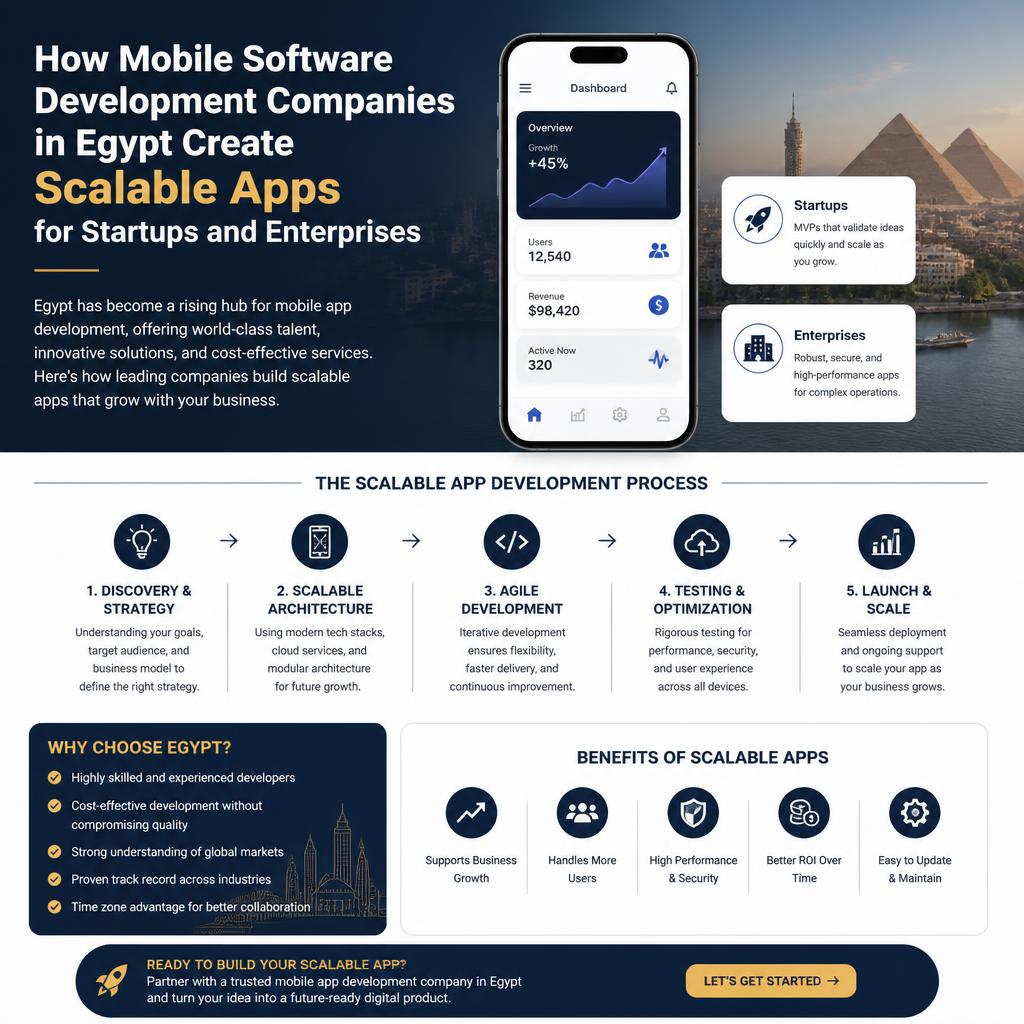
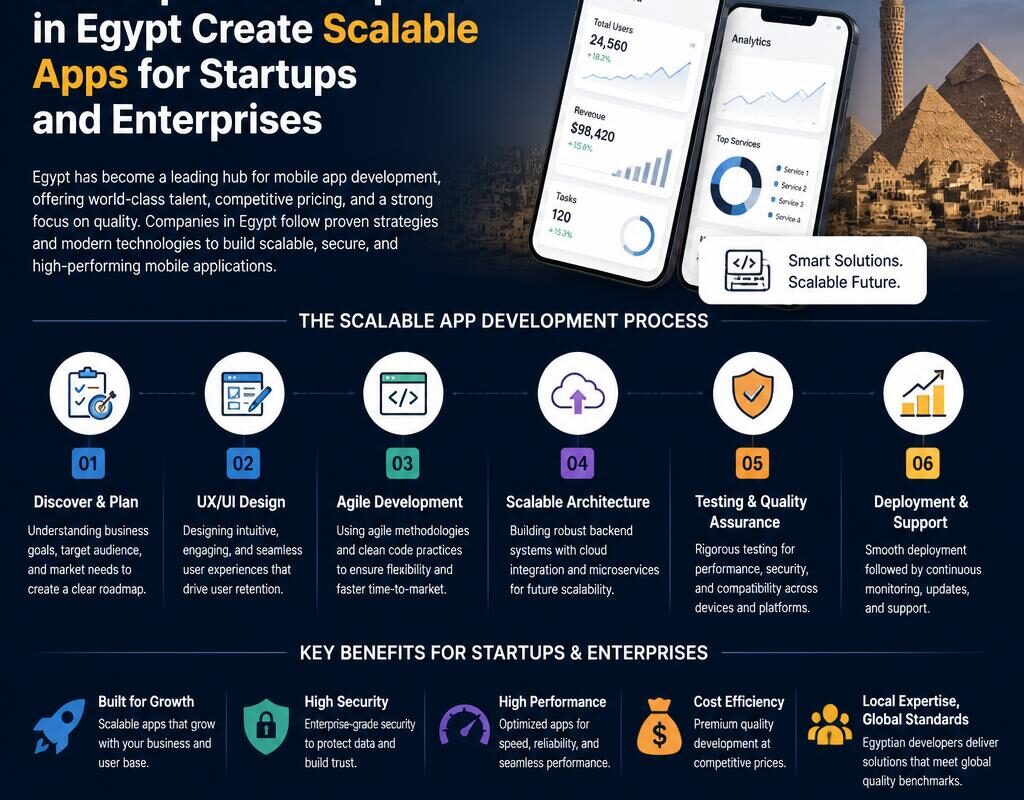
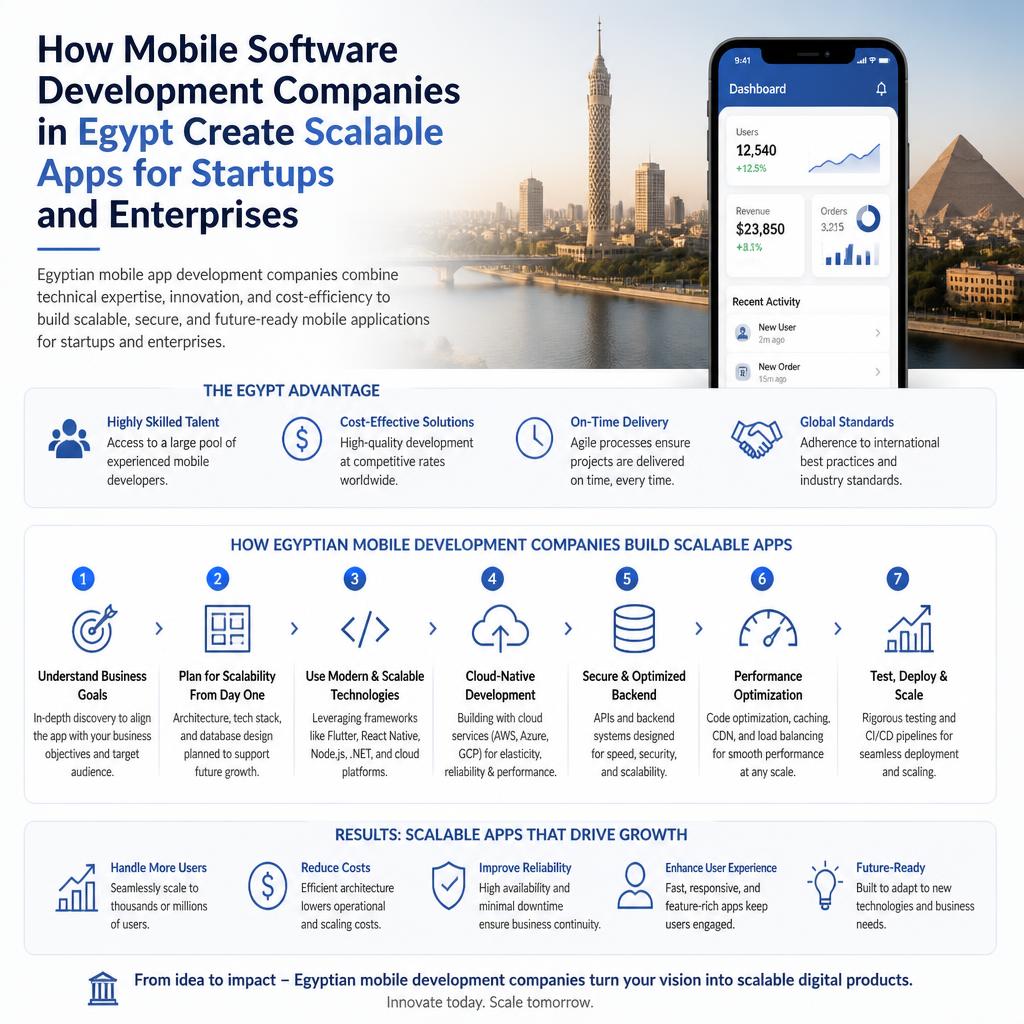
How Mobile Software Development Companies in Egypt Create Scalable Apps for Startups and Enterprises

A mobile application can begin as a simple idea and eventually become an important part of a
company’s entire digital ecosystem. A startup may initially need only a few core features, while
an established enterprise may require multiple user roles, complex integrations, advanced
security, analytics, and connections with existing business systems.

The challenge is making sure the application can evolve without becoming difficult or expensive
to maintain.

This is where mobile software development companies in Egypt can provide valuable
technical expertise. By combining product planning, modern development practices, cloud
technologies, scalable architecture, quality assurance, and ongoing support, development
teams can create applications designed to accommodate changing business requirements.

For startups, scalability can mean having a technical foundation that supports rapid user growth.
For enterprises, it can mean creating a dependable mobile platform that connects employees,
customers, partners, and internal systems.

In both situations, the goal is not simply to build an application that works today. The goal is to
create software that remains useful as the organization develops.

What Does a Scalable Mobile Application Mean?

A scalable mobile application is designed to handle increasing demand while maintaining
acceptable performance, reliability, and usability.

Growth can happen in several ways.

A company may experience:

  • More application users
  • More transactions
  • Larger databases
  • Additional geographic markets
  • New product categories
  • More employees
  • Additional integrations
  • New application features

A system that performs well with a small audience may struggle when demand increases if its
architecture was not designed appropriately.

Scalability therefore needs to be considered during the planning stage rather than treated as a
problem to solve after the application becomes successful.

Professional mobile software development services Egypt can help businesses determine
what level of scalability is appropriate for their expected growth and budget.

Why Do Startups Need Scalable Mobile Apps?

Startups operate under different conditions from established enterprises.

They often have limited budgets, uncertain market demand, and a need to validate their product
quickly.

However, building a basic MVP does not mean ignoring future development.

A startup may begin with a relatively small user base and later experience rapid adoption. If the
original architecture cannot accommodate that growth, the company may have to spend
significant resources rebuilding important parts of the application.

A better strategy is to create a focused first version using an architecture that allows reasonable
expansion.

For example, a startup developing a marketplace application might launch with:

  • User registration
  • Seller profiles
  • Product listings
  • Search
  • Shopping cart
  • Checkout
  • Basic order management

After the business gains traction, it could add recommendations, loyalty features, advanced
seller analytics, promotional tools, and automated communication.

The initial architecture should make these additions manageable.

Why Do Enterprises Require a Different Scalability
Strategy?

Large organizations often have more complicated requirements.

An enterprise application may need to support different departments, locations, permissions,
workflows, and software systems.

For example, a large organization could require separate access levels for:

  • Customers
  • Employees
  • Supervisors
  • Managers
  • Administrators
  • External partners

Each group may see different information and perform different actions.

This makes enterprise mobile app development Egypt more complex than simply creating a
larger version of a consumer application.

Enterprise applications may also need integration with ERP platforms, CRM systems,
databases, identity-management tools, analytics systems, and other corporate software.

The development architecture therefore needs to account for organizational complexity as well
as user growth.

How Do Development Companies Plan for Scalability?

Scalability starts with understanding the business.

Before writing significant amounts of code, a professional development team should consider:

  1. Who will use the application?
  2. How many users are expected initially?
  3. What growth is realistic?
  4. What types of transactions will occur?
  5. What data will be stored?
  6. Which external systems need integration?
  7. Which features may be introduced later?
  8. What performance level is required?
  9. What security controls are necessary?
  10. What infrastructure will support the application?

The answers help developers select an appropriate architecture.

This planning process prevents businesses from paying for unnecessary infrastructure while still
giving the application a practical path for growth.

The Role of Backend Architecture in Scalable
Applications

A mobile application may appear simple from the user’s perspective, but the backend can be
significantly more complex.

The backend may manage:

  • User accounts
  • Authentication
  • Permissions
  • Business rules
  • Transactions
  • Databases
  • Notifications
  • Files
  • Analytics
  • APIs
  • Third-party services

If the backend is poorly designed, increasing traffic can create performance problems even
when the mobile interface itself is well developed.

A scalable backend should therefore be designed around expected workloads.

Developers may use modular services, optimized databases, efficient APIs, caching, cloud
infrastructure, monitoring, and other engineering techniques depending on the project’s needs.

Why Are APIs Important for Business Applications?

APIs allow different software systems to exchange information.

Consider an e-commerce company.

Its mobile application may need information from:

Mobile App → API → Product Database

At checkout, additional systems may be involved:

Mobile App → API → Order System → Payment Service → Inventory System

A logistics application may similarly communicate with maps, driver-management software,
customer databases, and notification services.

Well-designed APIs make these connections easier to manage and expand.

Businesses evaluating a mobile app development company in Egypt should therefore ask
about API development and integration capabilities rather than focusing only on mobile interface
design.

How Does Cloud Technology Support Scalability?

Cloud infrastructure can provide businesses with flexible computing and storage resources.

Instead of relying entirely on fixed physical infrastructure, organizations can adjust resources
according to their requirements.

For a growing application, cloud technologies can support areas such as:

  • Application hosting
  • Database services
  • File storage
  • Traffic management
  • Monitoring
  • Backup
  • Content delivery
  • Automated deployment

The appropriate cloud architecture depends on the application’s requirements.

A small startup does not necessarily need a highly complex cloud environment from the first
day. An enterprise serving a large user base may require a more sophisticated infrastructure
strategy.

The important point is to choose infrastructure that matches actual business requirements and
future growth expectations.

How Can Developers Prevent Mobile Apps From
Becoming Slow?

Performance problems can damage user experience.

Users may abandon an application if pages take too long to load, interactions feel delayed, or
important functionality repeatedly fails.

Performance can be affected by:

  • Large images
  • Inefficient API requests
  • Poor database queries
  • Excessive background processing
  • Network dependency
  • Memory usage
  • Complex application logic
  • Poorly optimized code

Professional development teams can identify potential bottlenecks through profiling and
performance testing.

Optimization may include reducing unnecessary network requests, improving API responses,
optimizing assets, caching frequently used information, and improving backend queries.

Performance should be measured rather than assumed.

What Role Does Database Design Play in Scalability?

The database is one of the most important components of a scalable application.

As the number of users and transactions grows, inefficient database structures can become a
major performance limitation.

Developers need to consider:

  • Data relationships
  • Query efficiency
  • Indexing
  • Data volume
  • Backup requirements
  • Data consistency
  • Access patterns
  • Growth projections

A database designed for a few thousand records may behave differently when it contains
millions.

Good database architecture provides a foundation for future expansion without unnecessarily
complicating the initial application.

How Can Modular Development Help Startups and
Enterprises?

Modular architecture divides an application into logical components.

For example, an application could have separate modules for:

  • Authentication
  • User profiles
  • Payments
  • Notifications
  • Orders
  • Reporting
  • Administration

This structure can make it easier to modify or extend individual areas without affecting the entire
system.

For startups, modularity can support gradual product expansion.

For enterprises, it can make large applications easier to manage across different teams and
departments.

The exact architecture depends on the application’s size and technical requirements, but
modular thinking can improve long-term maintainability.

Should Startups Build an MVP Before a Full Application?

In many situations, yes.

A startup may have a long list of ideas but limited evidence about what customers actually want.

An MVP allows the company to test its core proposition with a focused product.

However, an MVP should be strategically limited rather than poorly engineered.

The development team can identify:

Must-have features → Useful future features → Experimental features

The first release focuses on the first category.

After launch, customer feedback and usage data can guide the next development cycle.

This approach can reduce wasted development effort while allowing the product to evolve
based on real-world evidence.

How Do Flutter and React Native Support Cross-Platform
Development?

Businesses often want applications for both Android and iOS.

Developing two completely separate applications can require additional resources. Cross-
platform technologies provide another approach.

Flutter Development

Flutter app development in Egypt can help businesses create applications for multiple
platforms using a shared development framework.

This approach can be useful for organizations that want:

  • Consistent user interfaces
  • Shared development resources
  • Efficient feature development
  • Android and iOS support
  • A streamlined maintenance strategy

Flutter may be appropriate for startups and businesses that value a unified cross-platform
development approach.

React Native Development

React Native app development in Egypt can also be considered when businesses want to
support multiple mobile platforms with a shared codebase.

It can be suitable for various applications, including:

  • Customer platforms
  • Marketplace applications
  • Business tools
  • Service applications
  • MVPs

The choice between Flutter, React Native, and native development should be based on project
requirements rather than popularity alone.

Why Is UI Architecture Important for Growing Apps?

Scalability is not only a backend concern.

The user interface also needs to accommodate additional functionality without becoming
confusing.

Imagine an application that begins with five screens and eventually grows to fifty.

If navigation was not designed with expansion in mind, users may struggle to find important
features.

A scalable UI strategy considers:

  • Navigation patterns
  • Information hierarchy
  • Reusable components
  • User roles
  • Feature grouping
  • Accessibility
  • Localization
  • Future functionality

Reusable design components can also help maintain visual consistency as the application
expands.

How Can Arabic Localization Improve Mobile Experiences
in Egypt?

Businesses targeting Egyptian audiences may need applications that support Arabic users
naturally.

Arabic localization involves more than translating words.

The application may need:

  • Right-to-left layouts
  • Arabic typography
  • Appropriate text alignment
  • RTL navigation
  • Localized dates and numbers
  • Proper form layouts
  • Bilingual content management

If Arabic and English are both required, the underlying interface should be designed to
accommodate both languages from the beginning.

Trying to add RTL support after the application has been completed can create unnecessary
redesign work.

How Do Scalable Apps Handle Different User Roles?

Many business applications serve multiple types of users.

For example, a delivery platform may include:

Customer → Driver → Dispatcher → Manager → Administrator

Each role may require different capabilities.

A customer should not have access to administrative functions.

A driver may need delivery information but not financial reports.

A manager may require operational dashboards.

Role-based access controls can help separate these permissions.

This becomes especially important in enterprise mobile app development in Egypt, where
applications may be used across departments and organizational levels.

What Security Measures Should Scalable Apps Include?

A growing application can become a larger target for security threats.

Security should therefore be integrated into the architecture from the beginning.

Depending on the application, development teams may implement:

  • Secure authentication
  • Role-based authorization
  • Protected APIs
  • Encryption
  • Secure session handling
  • Input validation
  • Access controls
  • Secure storage
  • Logging
  • Security testing

As the application grows, security requirements may also become more complex.

Regular updates and monitoring can help organizations respond to new vulnerabilities and
changes in the technology environment.

How Does Automated Testing Help Growing
Applications?

As applications gain features, manual testing becomes increasingly difficult.

A change to one feature can unintentionally affect another.

Automated testing can help developers verify important functionality consistently.

Testing strategies may include:

Unit Testing

Checks individual components or functions.

Integration Testing

Verifies that different systems work together correctly.

UI Testing

Evaluates important user interactions.

API Testing

Checks communication between applications and backend services.

Performance Testing

Examines application behavior under different workloads.

Regression Testing

Ensures new changes have not broken existing functionality.

A strong testing strategy can reduce the risk associated with frequent application updates.

Why Is Monitoring Necessary After Launch?

Scalability cannot be confirmed simply by launching the application.

Real-world users can reveal problems that were not visible during development.

Monitoring can provide information about:

  • Application errors
  • API failures
  • Server performance
  • Response times
  • Database activity
  • Crash rates
  • Traffic patterns

These insights can help development teams identify problems before they become major
disruptions.

For growing businesses, monitoring is particularly valuable because application usage can
change quickly.

What Should Businesses Expect From Mobile Software
Development Services?

A professional development engagement should provide more than coding.

Depending on the provider and project scope, mobile software development services Egypt
may include:

  • Business analysis
  • Technical consulting
  • UI/UX design
  • Mobile development
  • Backend engineering
  • API integration
  • Cloud deployment
  • Quality assurance
  • Security testing
  • App store deployment
  • Maintenance
  • Performance optimization

Businesses should confirm exactly which services are included in a proposal.

This prevents misunderstandings about responsibilities and project scope.

How Should Startups and Enterprises Select a
Development Partner?

The ideal development partner depends on the organization’s needs.

Startups should look for teams that can:

  • Work within realistic budgets
  • Prioritize MVP functionality
  • Move efficiently
  • Provide strategic technical guidance
  • Build an expandable foundation

Enterprises may need teams capable of:

  • Complex integrations
  • Large-scale architecture
  • Advanced security
  • Multiple user roles
  • Corporate software integration
  • Long-term maintenance
  • Large development teams

A company may therefore be an excellent fit for one type of organization but not another.

The selection should be based on actual project requirements.

What Questions Should Businesses Ask Development
Companies?

Before starting a project, decision-makers can ask:

How will you design the application for future growth?

The provider should explain its approach to architecture, infrastructure, APIs, and databases.

How will you handle increased users?

Ask how performance and infrastructure can be adapted as traffic grows.

Which technology do you recommend?

The answer should include reasoning related to the specific application.

How will the application integrate with existing software?

This is especially important for enterprise projects.

How will security be implemented?

Ask about authentication, permissions, APIs, storage, and testing.

What happens after launch?

Clarify maintenance, updates, monitoring, and support.

How will new features be added?

The development process should support controlled product expansion.

How Can Businesses Keep Mobile App Development
Cost Under Control?

Scalability does not require unlimited spending.

One of the most effective strategies is prioritization.

Businesses should distinguish between essential functionality and optional features.

For example:

Initial Release

  • Core user journey
  • Essential account functionality
  • Primary transaction
  • Basic notifications
  • Required administration

Later Releases

  • Advanced analytics
  • Personalization
  • Loyalty programs
  • Additional integrations
  • Automation
  • AI-based functionality

This phased approach allows companies to invest according to actual business performance.

Development costs can also be influenced by platform choice, design complexity, integrations,
security requirements, backend architecture, testing scope, and maintenance expectations.

A detailed technical scope is therefore more useful than relying on a generic development price.

What Is the Future of Scalable Mobile Applications?

Mobile applications are increasingly becoming connected components of broader digital
ecosystems.

Future-ready applications may interact with:

  • Artificial intelligence
  • Cloud platforms
  • Business intelligence
  • Automation systems
  • IoT devices
  • Location technologies
  • Digital payment systems
  • Enterprise software

For startups, this could create opportunities to introduce intelligent features after achieving
product-market validation.

For enterprises, it could allow mobile applications to become interfaces for larger digital
transformation initiatives.

The key is flexibility.

Businesses do not need to implement every emerging technology immediately. They need an
architecture that can accommodate relevant technologies when they create genuine business
value.

Frequently Asked Questions

What makes a mobile app scalable?

A scalable mobile application uses an architecture, backend, database, APIs, and infrastructure
capable of handling increasing users, data, transactions, and functionality without requiring a
complete rebuild.

Why should startups invest in scalable app development?

Startups benefit from a scalable foundation because successful products may experience rapid
user growth. A flexible architecture can make future expansion easier while allowing the first
version to remain focused.

What is enterprise mobile app development?

Enterprise mobile app development involves creating applications for organizational use, often
including multiple user roles, advanced security, internal workflows, corporate integrations,
analytics, and complex backend systems.

Are mobile software development companies in Egypt suitable for
startups?

Yes. Egyptian development teams can work with startups on MVPs, customer applications,
cross-platform products, backend systems, and future product expansion, depending on their
individual capabilities and experience.

Is Flutter good for scalable applications?

Flutter can be suitable for scalable applications when its architecture, backend systems, APIs,
and overall technical design are appropriate for the project’s requirements. Scalability depends
on the entire system rather than the framework alone.

Is React Native suitable for growing businesses?

React Native can be considered for growing businesses that need cross-platform mobile
applications. The suitability depends on performance requirements, integrations, platform-
specific functionality, and the project’s long-term technical strategy.

Can a scalable app support Arabic and English?

Yes. Applications can be designed to support Arabic and English, including appropriate right-to-
left behavior for Arabic interfaces. Bilingual requirements should ideally be considered during
the initial UX and architecture stages.

Do scalable mobile apps require cloud infrastructure?

Not necessarily in every case, but cloud infrastructure can provide useful flexibility for
applications that experience changing workloads or require scalable hosting, storage,
databases, monitoring, and deployment systems.

Final Thoughts

Building a mobile application that can grow requires careful decisions long before the first
version reaches users.

Startups need enough technical flexibility to expand after validating their ideas. Enterprises
need architecture capable of supporting complex workflows, multiple users, integrations,
security requirements, and organizational growth.

This is why choosing experienced mobile software development companies in Egypt can be
an important step for businesses planning serious mobile products.

The strongest development strategy combines business understanding with appropriate
technology. It considers backend architecture, APIs, databases, cloud infrastructure, user
experience, security, testing, monitoring, and maintenance as connected parts of one system.

A scalable application should not be unnecessarily complicated. It should simply be designed
with a realistic understanding of where the business is today and where it intends to go.

For Egyptian startups and enterprises, that balance can turn a mobile application from a short-
term digital project into a platform capable of supporting long-term business growth.

Categories Blog

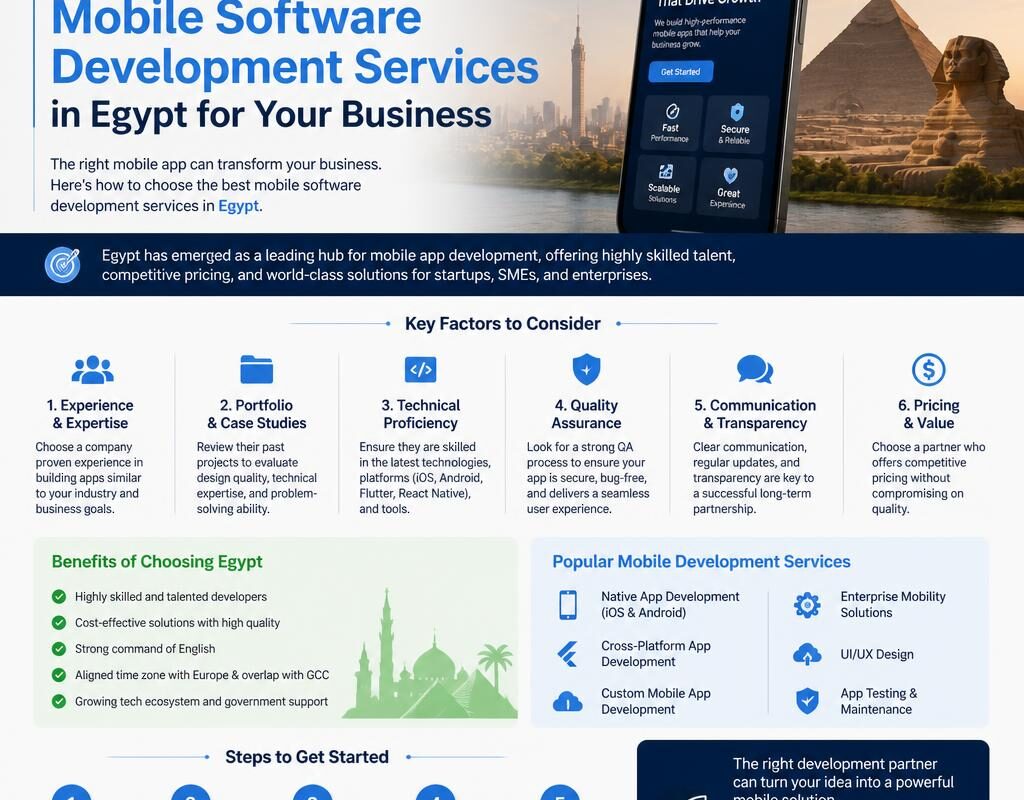
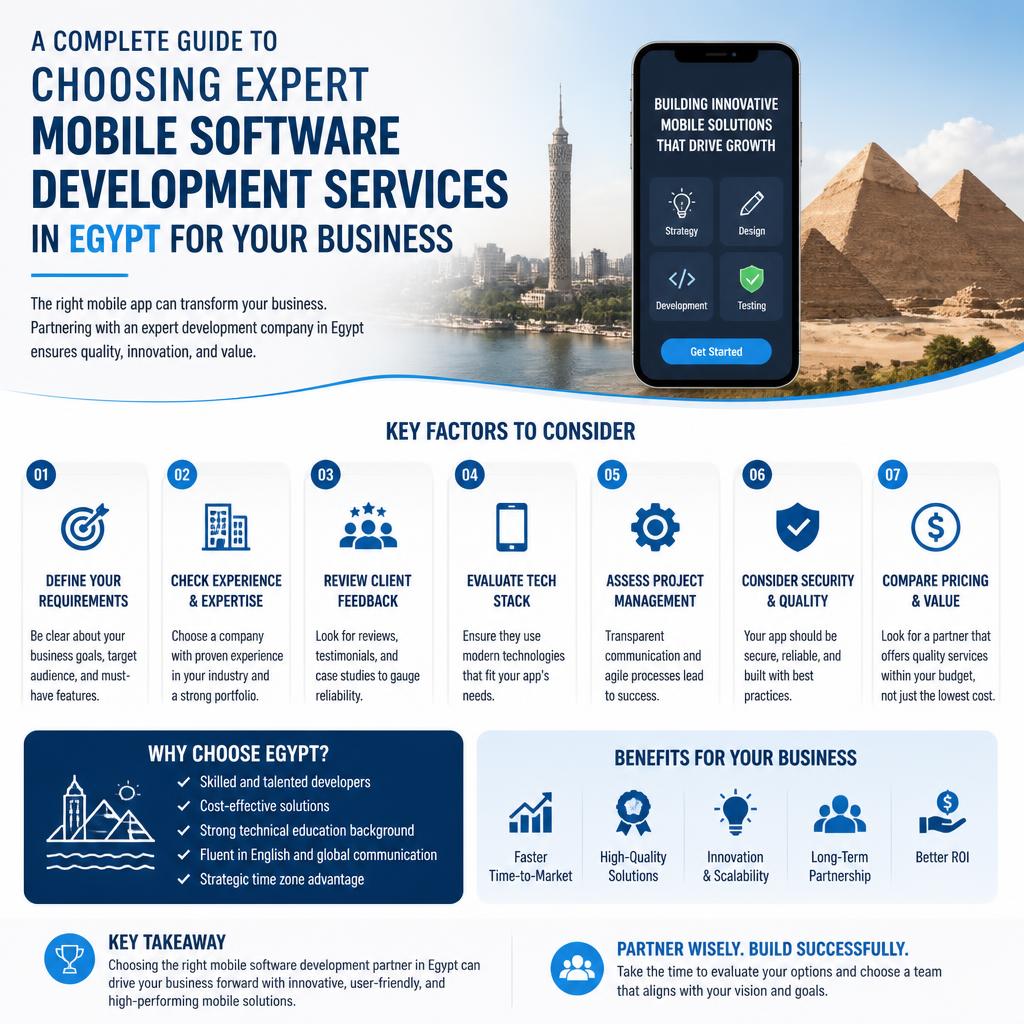
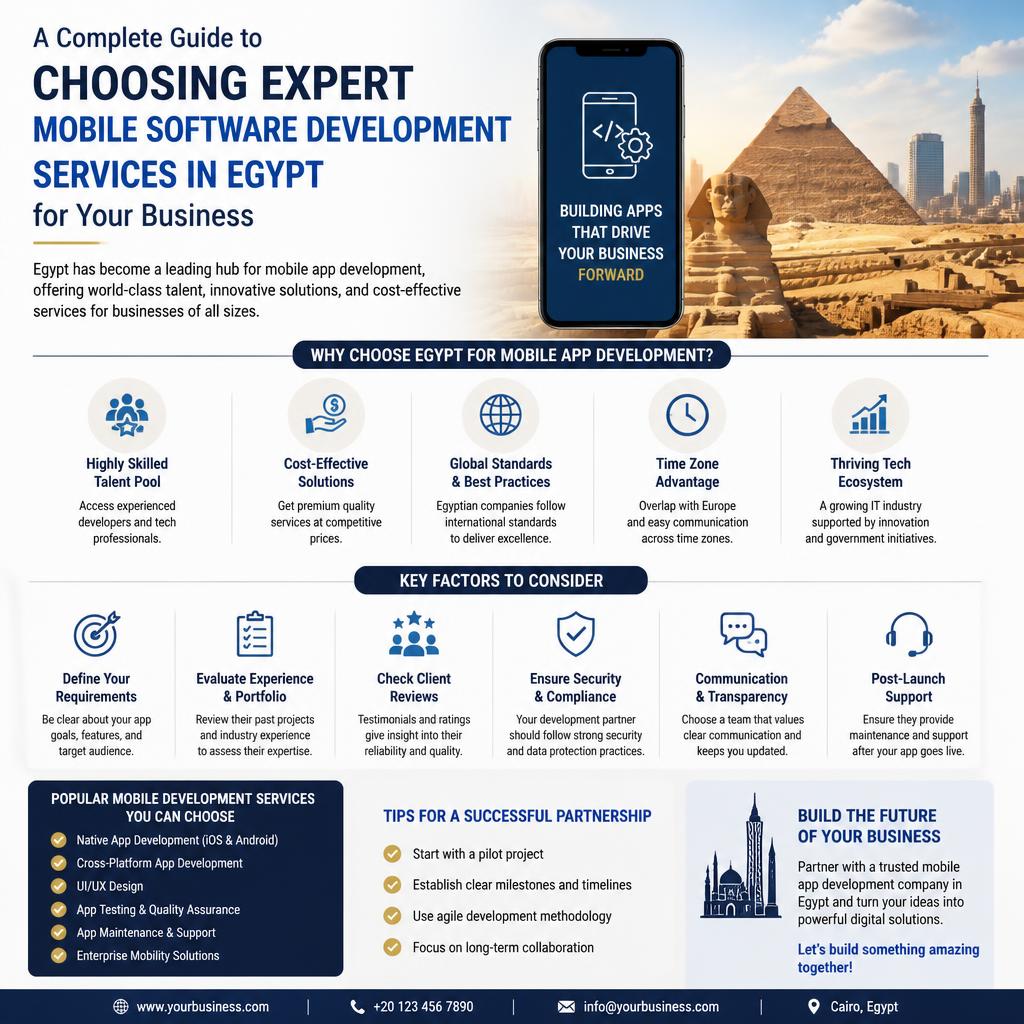
A Complete Guide to Choosing Expert Mobile Software Development Services in Egypt for Your Business

Choosing the right technology partner can have a major impact on how successfully a business
launches, grows, and maintains its mobile presence. With customers increasingly using
smartphones for shopping, communication, payments, bookings, and business interactions,
companies need applications that are dependable, easy to use, and capable of supporting
changing demands.

For organizations evaluating Expert Mobile Software Development Services in Egypt, the
challenge is not simply finding developers who can write code. A reliable development partner
should understand business objectives, user expectations, security requirements, technical
architecture, and long-term product growth.

This guide explains what Egyptian businesses should consider before selecting a development
company and how to identify a partner capable of turning an app concept into a practical digital
product.

What Are Expert Mobile Software Development Services?

Mobile Software Development Services Egypt cover the complete process of planning,
designing, developing, testing, launching, and maintaining applications for smartphones and
tablets.

Professional development teams can create applications for different business requirements,
including:

  • Customer-facing mobile applications
  • Employee and internal business apps
  • E-commerce applications
  • Booking and appointment platforms
  • Delivery and logistics applications
  • Financial and payment solutions
  • Educational applications
  • Healthcare platforms
  • On-demand service apps
  • Enterprise mobility solutions

The strongest development projects begin with business requirements rather than technology
selection. Instead of choosing a framework first, businesses should identify the problem they
want the application to solve and then select technologies that support those objectives.

Why Choosing the Right Development Partner Matters

An application represents more than a digital interface. It can become a major customer
touchpoint and an important part of internal operations.

A poorly planned application may experience slow performance, confusing navigation, security
weaknesses, compatibility problems, or expensive maintenance requirements. These issues
can affect customer satisfaction and increase development costs later.

Working with an experienced Mobile App Development Company in Egypt can help
businesses establish a clearer development roadmap from the beginning.

The right partner can help with:

  • Business and technical requirement analysis
  • Product planning
  • UI/UX design
  • Mobile application development
  • Backend development
  • API integration
  • Database architecture
  • Quality assurance
  • Application deployment
  • Performance optimization
  • Security implementation
  • Post-launch maintenance

This full-cycle approach reduces the risk of treating mobile development as an isolated coding
project.

Start With Your Business Objectives

Before contacting development companies, define what you want the application to accomplish.

For example, an Egyptian retailer may want to increase online orders, while a logistics company
may need better delivery coordination. A healthcare organization might require appointment
scheduling, whereas an educational business may need mobile access to courses and learning
materials.

Write down the primary purpose of the application and identify measurable outcomes.

Ask questions such as:

  • What business problem will the application address?
  • Who will use it?
  • What actions should users complete?
  • Which existing systems need to connect with the app?
  • What features are essential for the first release?
  • What functionality can be introduced later?
  • How will success be measured?

Clear answers allow developers to estimate the project more accurately and recommend an
appropriate technical strategy.

Evaluate Experience Beyond a Portfolio

A development portfolio can demonstrate what a company has built, but it does not tell the
entire story.

When comparing providers of Expert Mobile Software Development Services Egypt,
investigate whether their previous projects demonstrate relevant technical and business
experience.

Look for experience with:

  • Similar industries
  • Comparable user volumes
  • Complex integrations
  • Multi-role applications
  • Payment systems
  • Location-based functionality
  • Real-time communication
  • Enterprise applications
  • Cloud infrastructure
  • Data-intensive applications

A visually attractive portfolio is useful, but businesses should also understand how those
applications were engineered and maintained.

Ask potential developers what challenges they encountered in previous projects and how those
challenges were solved. Their answers can reveal much more about their capabilities than
screenshots alone.

Examine Their Mobile Development Technologies

Technology choices should support the application’s requirements rather than simply follow
current trends.

Depending on the project, businesses may consider native or cross-platform development.

Native Application Development

Native development involves building applications specifically for operating systems such as
Android or iOS.

It can be appropriate when an application requires:

  • Advanced device capabilities
  • High-performance functionality
  • Platform-specific experiences
  • Extensive hardware integration
  • Complex animations or processing

Businesses looking for Android App Development Egypt or iOS App Development Egypt
should ask whether the development team has experienced specialists for their chosen
platform.

Cross-Platform Development

Cross-platform technologies can allow businesses to develop applications for multiple operating
systems from a shared codebase.

Frameworks such as Flutter and React Native are commonly considered for projects where
development efficiency and consistent functionality across platforms are important.

For businesses exploring Flutter App Development Services in Egypt, the development
partner should be able to explain where Flutter is appropriate and where native implementation
may be more suitable.

Similarly, organizations considering React Native Development Services in Egypt should
evaluate the team’s experience with performance optimization, native integrations, APIs, and
production deployment.

The best technology decision depends on the application’s functionality, budget, timeline,
expected growth, and maintenance requirements.

Pay Attention to UI/UX Capabilities

An application can have excellent backend technology and still fail to satisfy users if its interface
is difficult to navigate.

During the selection process, examine how the company approaches user experience.

A professional UI/UX process should consider:

  • User journeys
  • Navigation structure
  • Screen hierarchy
  • Accessibility
  • Mobile usability
  • Visual consistency
  • Error handling
  • Loading states
  • Different device sizes

For Egyptian businesses serving diverse audiences, language and localization can also matter.
Applications may need Arabic interfaces, English interfaces, or a bilingual experience
depending on their target users.

A good development company should consider these requirements during the design stage
rather than treating localization as an afterthought.

Check Backend and Integration Expertise

Modern applications rarely operate independently.

A mobile app may need to communicate with websites, CRM platforms, ERP systems, payment
gateways, inventory software, logistics platforms, authentication services, analytics tools, and
third-party APIs.

This makes backend expertise an important part of Mobile Application Development Egypt
projects.

Ask prospective developers about their experience with:

  • REST and other APIs
  • Cloud services
  • Database systems
  • Authentication
  • Third-party integrations
  • Payment gateways
  • Push notifications
  • Real-time data
  • Admin dashboards
  • Analytics systems

A well-designed backend can make future upgrades easier and prevent the mobile application
from becoming dependent on a fragile technical foundation.

Security Should Be a Core Requirement

Security should never be added only after an application has been developed.

Applications may process customer information, business records, payment information,
credentials, location information, or other sensitive data. Developers should therefore consider
security throughout the architecture and development lifecycle.

When evaluating Custom Mobile App Development Egypt providers, ask how they handle:

  • Secure authentication
  • Authorization
  • Data encryption
  • API protection
  • Secure storage
  • Session management
  • Input validation
  • Dependency management
  • Security testing
  • Data access controls

Businesses should also understand how security updates will be handled after launch.

A development partner that treats security as an ongoing responsibility is generally better
positioned to support a long-term mobile product.

Understand the Development Process

A transparent process makes collaboration easier.

Before signing a contract, ask the development company to explain its workflow.

A typical process may include:

1. Discovery

The team studies business objectives, users, competitors, requirements, and technical
constraints.

2. Planning

Features, milestones, technology requirements, resources, and priorities are defined.

3. UX and UI Design

User journeys, wireframes, prototypes, and visual interfaces are created.

4. Development

Developers build the application, backend services, APIs, integrations, and supporting systems.

5. Testing

The application is tested for functionality, compatibility, usability, security, and performance.

6. Deployment

The completed product is prepared for the relevant app stores and production infrastructure.

7. Maintenance

After launch, the team handles improvements, bug fixes, compatibility updates, monitoring, and
future functionality.

A clearly defined process gives businesses better visibility into progress and responsibilities.

Ask How They Handle Scalability

An application that works for 1,000 users may require significant architectural changes when the
audience reaches hundreds of thousands.

Businesses should therefore discuss scalability before development begins.

A scalable solution may involve:

  • Flexible backend architecture
  • Efficient database design
  • Cloud infrastructure
  • API optimization
  • Caching
  • Modular application components
  • Load management
  • Monitoring and analytics

Companies seeking Custom Software Development Egypt should also consider whether the
application can eventually connect with additional business systems.

Scalability is not only about handling more users. It also means making it easier to introduce
new features without rebuilding the entire application.

Compare Pricing Carefully

Cost is naturally an important factor when selecting a development company, but the lowest
quotation may not provide the best overall value.

Two providers can quote different prices for the same project because their proposals may differ
in:

  • Development methodology
  • Technology choices
  • Team experience
  • Testing coverage
  • UI/UX quality
  • Security practices
  • Infrastructure
  • Project management
  • Maintenance
  • Post-launch support

Instead of asking only, “How much will the app cost?”, businesses should ask what is included
in the quotation.

A detailed proposal should explain the scope, deliverables, milestones, assumptions,
integrations, testing, deployment, and support arrangements.

This makes comparisons between providers more meaningful.

Confirm Post-Launch Support

Launching the application is only the beginning of its lifecycle.

Operating systems change, devices evolve, third-party services are updated, and customers
continuously request improvements.

Reliable Mobile App Maintenance Egypt services can help businesses manage these
changes.

Post-launch support may include:

  • Bug resolution
  • Performance monitoring
  • Security updates
  • Operating system compatibility
  • Feature enhancements
  • API updates
  • Database maintenance
  • App store updates

Before selecting a development partner, determine whether maintenance is included in the
project or offered through a separate support agreement.

Look for Strong Communication

Technical expertise is important, but communication can strongly influence the success of a
development project.

A development partner should make it easy for business stakeholders to understand:

  • What has been completed
  • What is currently being developed
  • What decisions are required
  • What risks exist
  • Whether the timeline has changed
  • How new requirements affect the budget

Regular meetings, progress reports, project management systems, and clear documentation
can keep both sides aligned.

For complex Enterprise Mobile App Development in Egypt, structured communication
becomes especially important because multiple departments and stakeholders may participate
in the project.

Consider Future Feature Expansion

Your first application release should not necessarily contain every possible feature.

A better approach can be to identify the core functionality needed for launch and create a
roadmap for future improvements.

For example, an initial business application might provide:

  • Account creation
  • Product or service browsing
  • Search
  • Orders or bookings
  • Payments
  • Notifications

Later releases could introduce loyalty programs, personalized recommendations, advanced
analytics, AI features, or deeper integrations.

This approach allows businesses to validate the product while keeping the initial development
scope manageable.

Questions to Ask Before Hiring a Development Company

Before making the final decision, Egyptian businesses can ask potential development partners:

  • 1.Have you developed applications similar to ours?
  • Which technology would you recommend and why?
  • Who will work directly on our project?
  • How will requirements and changes be managed?
  • How do you test mobile applications?
  • How will the application be secured?
  • Can the architecture support future growth?
  • What third-party integrations can you handle?
  • What is included in the development quotation?
  • What support will be available after launch?

The answers can help distinguish between a company simply offering development capacity
and a partner capable of understanding the complete business requirement.

How to Select the Right Mobile Development Partner in
Egypt

After comparing potential companies, create a simple evaluation framework.

Consider each provider based on:

Technical capability: Can the team build the required functionality?

Industry understanding: Do they understand the challenges of your market?

Communication: Can they explain technical decisions clearly?

Development methodology: Is there a structured process for planning, testing, and delivery?

Scalability: Can the proposed architecture support future growth?

Security: Are security considerations incorporated throughout development?

Support: Will the team remain available after launch?

Value: Does the proposal provide appropriate quality for the investment?

This approach helps businesses make decisions based on overall value rather than price alone.

    Why Egyptian Businesses Should Take a Long-Term
    Approach

    Mobile applications can become important components of a company’s digital infrastructure.
    They may support customer acquisition, sales, employee productivity, communication,
    operations, or service delivery.

    That is why choosing Mobile Software Development Services Egypt should be viewed as a
    long-term technology decision.

    A development company should not only be capable of delivering the first version but should
    also understand how the application can evolve as business requirements change.

    For startups, this may mean creating a focused MVP that can be expanded after market
    validation. For established organizations, it may involve integrating the application with existing
    enterprise systems and creating a scalable architecture.

    Final Thoughts

    Selecting the right provider of Expert Mobile Software Development Services in Egypt
    requires more than comparing portfolios and quotations. Businesses should evaluate technical
    expertise, development methodology, security, scalability, communication, UI/UX capabilities,
    integrations, and long-term support.

    The right Mobile App Development Company in Egypt can help transform a business
    requirement into a reliable mobile product while creating a technical foundation for future
    growth.

    Whether the project involves Custom Mobile App Development in Egypt, enterprise mobility,
    Android and iOS applications, or cross-platform development, careful partner selection can
    reduce risks and improve the application’s long-term value.

    The goal should not simply be to launch an application. It should be to build a mobile solution
    that serves users effectively, supports business objectives, and remains adaptable as the
    Egyptian digital market continues to evolve.

    Frequently Asked Questions

    What should businesses consider when choosing mobile software
    development services in Egypt?

    Businesses should evaluate technical experience, relevant project expertise, UI/UX capabilities,
    security practices, development methodology, scalability, communication, pricing transparency,
    and post-launch support.

    How much does custom mobile app development cost in Egypt?

    The cost depends on factors such as application complexity, number of platforms, features,
    integrations, design requirements, backend architecture, security needs, and ongoing
    maintenance. A detailed project specification is normally required for a reliable estimate.

    Should an Egyptian business choose native or cross-platform
    development?

    There is no universal answer. Native development can be useful for highly platform-specific or
    performance-intensive applications, while cross-platform development can be efficient when
    businesses need consistent functionality across Android and iOS.

    Why is scalability important for a mobile application?

    Scalability allows an application to accommodate increasing users, transactions, data, and
    functionality without requiring a complete technical rebuild.

    Is post-launch mobile app maintenance necessary?

    Yes. Operating systems, devices, APIs, security requirements, and user expectations change
    over time. Ongoing maintenance helps keep an application secure, compatible, and reliable.

    How can businesses find reliable mobile app developers in Egypt?

    Businesses should compare relevant experience, technical capabilities, development
    processes, client references, communication practices, security standards, pricing, and long-
    term support before selecting a development partner.

    Categories Blog

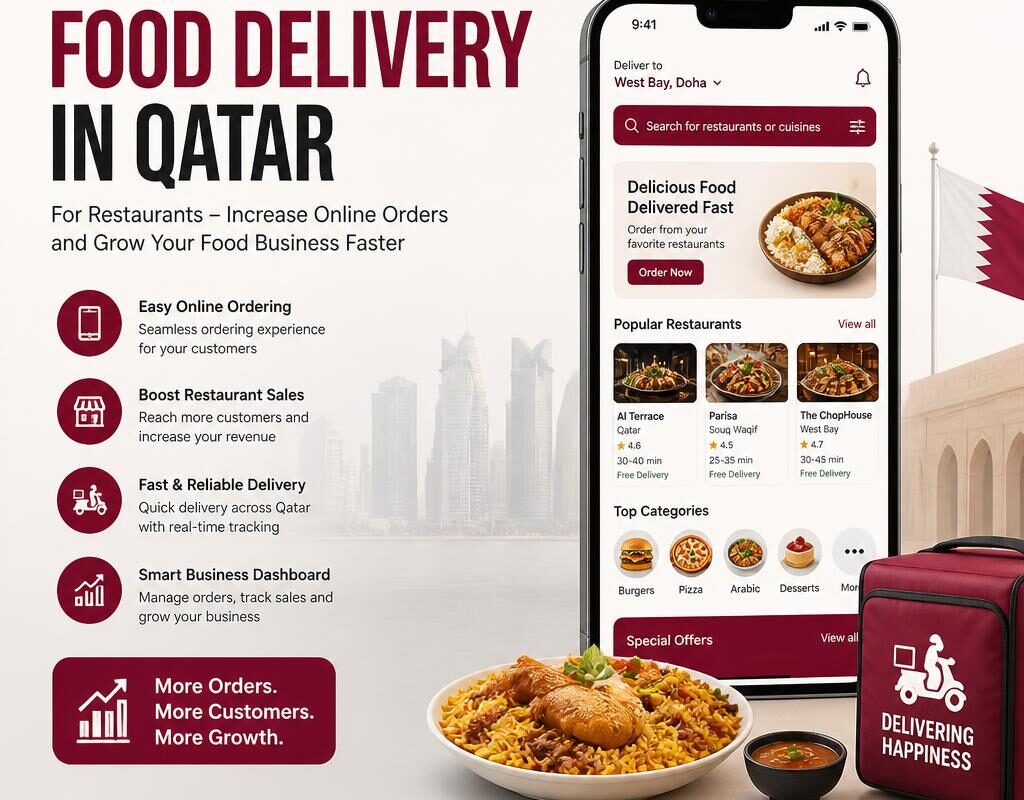
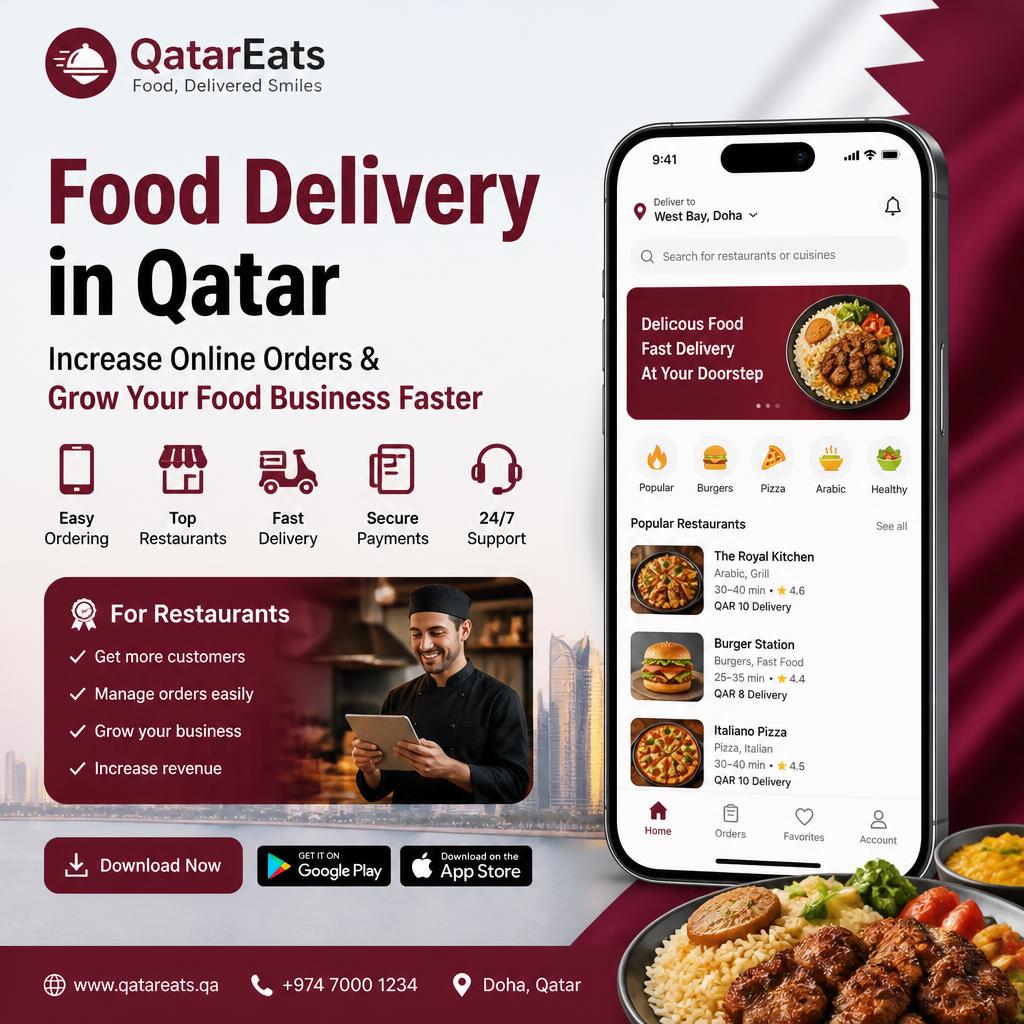
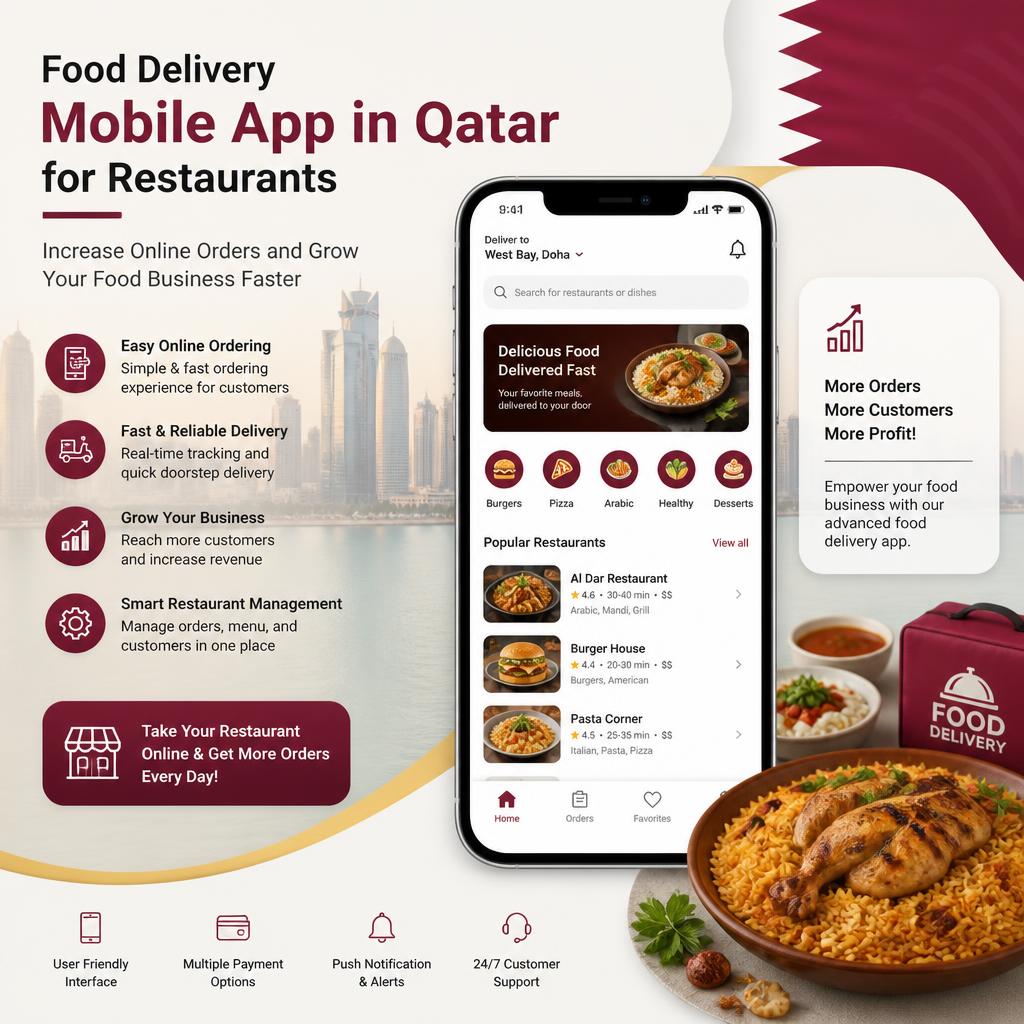
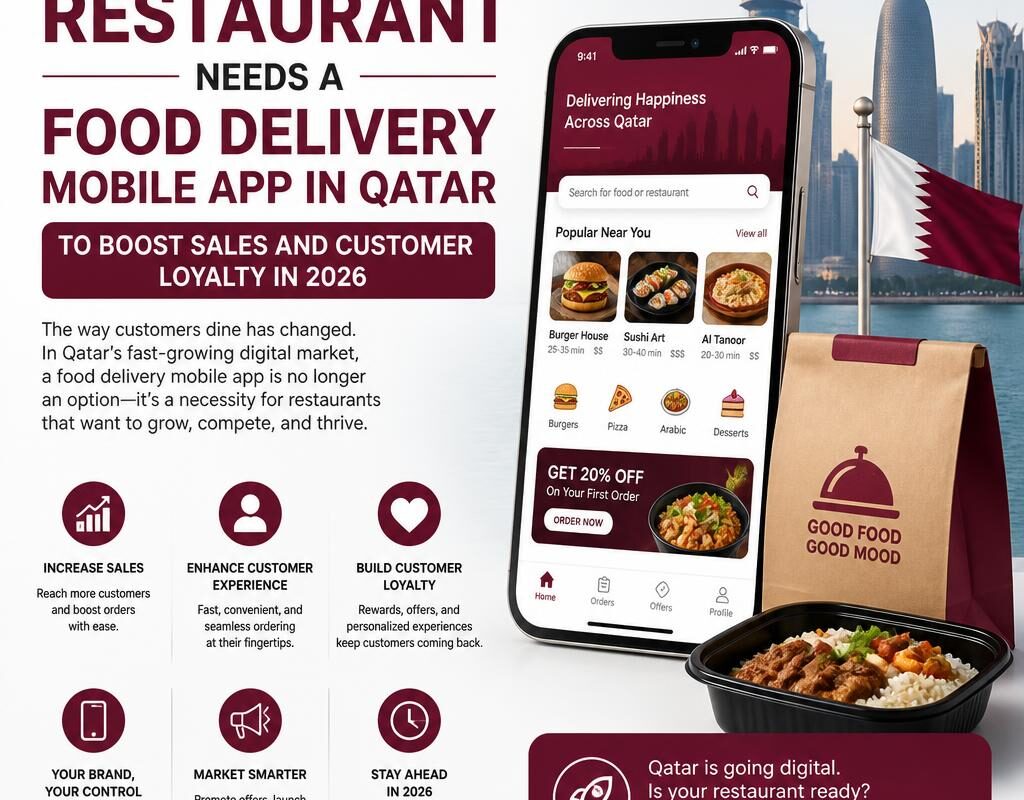
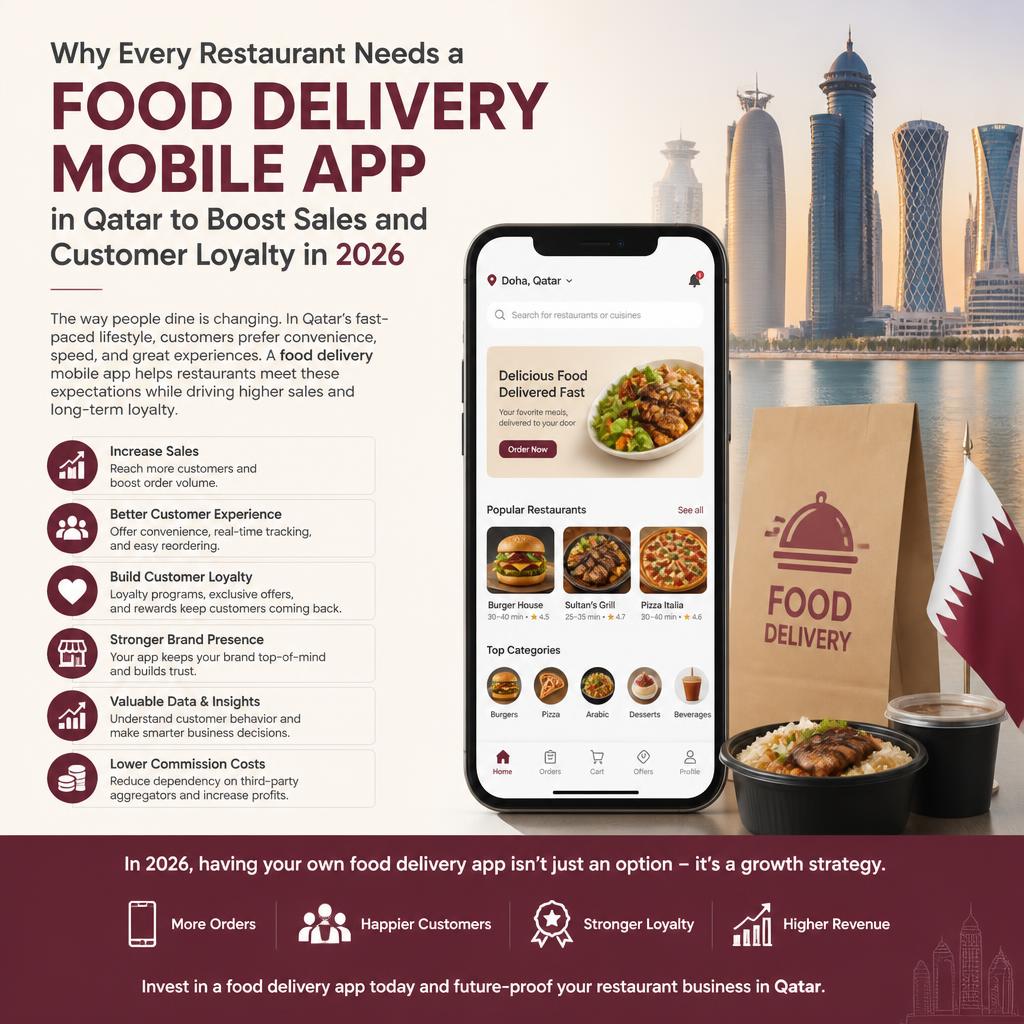
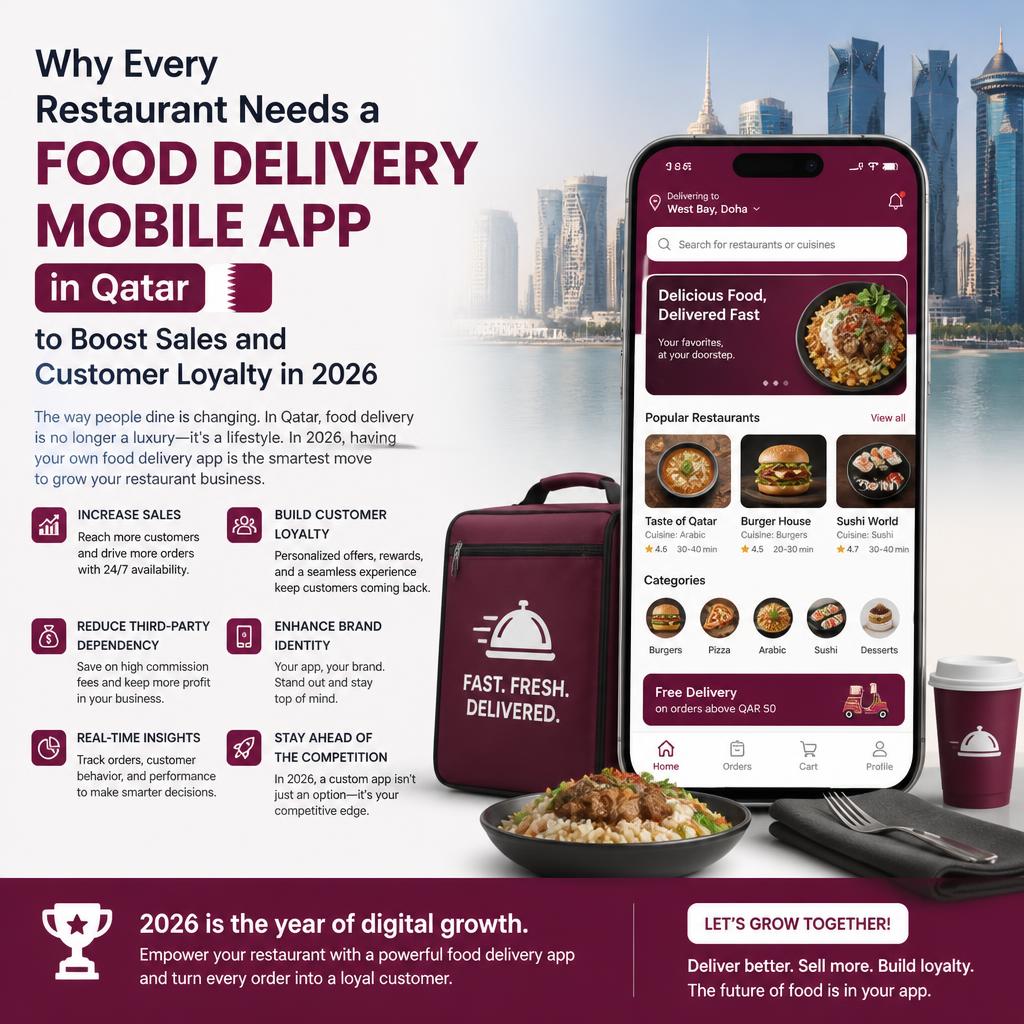
    Food Delivery Mobile App in Qatar for Restaurants – Increase Online Orders and Grow Your Food Business Faster

    The food industry in Qatar is experiencing a remarkable digital transformation. Customers
    increasingly expect convenience, fast delivery, and seamless online ordering, making mobile
    apps an essential part of restaurant success. Whether you own a café, cloud kitchen, fine-dining
    restaurant, or multi-location food chain, investing in a Food Delivery Mobile App in Qatar can
    help you serve more customers, improve operational efficiency, and generate higher revenue.

    As consumer behavior continues to shift toward digital experiences, restaurants that rely only on
    traditional ordering methods risk falling behind competitors. A professionally designed food
    delivery application enables businesses to accept online orders 24/7, reduce manual errors,
    strengthen customer loyalty, and create personalized dining experiences.

    If you’re looking to expand your restaurant business, now is the ideal time to invest in a modern
    food delivery solution.

    Why Restaurants in Qatar Need a Food Delivery Mobile
    App

    The restaurant market in Qatar is highly competitive. Customers have countless dining options,
    and many prefer ordering food directly through mobile applications instead of calling restaurants
    or visiting in person.

    A dedicated Food Delivery Mobile App in Qatar helps restaurants:

    • Accept online orders anytime
    • Improve customer convenience
    • Increase repeat purchases
    • Offer faster order processing
    • Build stronger brand recognition
    • Reduce dependency on third-party delivery marketplaces
    • Improve customer satisfaction through real-time updates

    Owning your own application gives you complete control over your customer relationships,
    promotions, pricing, and marketing strategies.

    Key Benefits of a Food Delivery Mobile App for
    Restaurants

    1. Increase Online Orders

    Customers appreciate the simplicity of browsing menus, customizing meals, and placing orders
    within minutes. A smooth ordering experience encourages more frequent purchases and
    improves conversion rates.

    Restaurants using a Food Delivery Mobile App in Qatar often experience increased online
    sales because customers can order whenever they want without waiting on phone calls.

    2. Strengthen Customer Loyalty

    A dedicated app helps restaurants build lasting relationships with customers through:

    • Loyalty rewards
    • Cashback offers
    • Discount coupons
    • Referral programs
    • Personalized recommendations

    These features encourage repeat business while enhancing customer engagement.

    3. Improve Brand Visibility

    Unlike third-party delivery platforms where restaurants compete side by side, your own branded
    application keeps your business at the center of the customer experience.

    Every interaction strengthens your restaurant’s identity while creating long-term customer
    recognition.

    4. Simplify Restaurant Operations

    Managing food orders manually often leads to delays and mistakes.

    A modern Restaurant Food Delivery App in Qatar streamlines operations by:

    • Automatically receiving orders
    • Managing inventory
    • Tracking deliveries
    • Sending kitchen notifications
    • Updating order status instantly

    This automation allows restaurant staff to focus more on food quality and customer service.

    Essential Features Every Food Delivery Mobile App in
    Qatar Should Include

    Creating a successful application involves much more than displaying a digital menu.

    Some must-have features include:

    • Easy customer registration
    • Secure login options
    • Smart menu management
    • Category-wise food browsing
    • Advanced search filters
    • Real-time order tracking
    • Multiple payment methods
    • Wallet integration
    • Scheduled deliveries
    • Push notifications
    • Ratings and reviews
    • Live chat support
    • Order history
    • Favorite meals
    • Promo code support
    • Delivery partner tracking

    These features create a seamless ordering experience while improving customer satisfaction.

    How Restaurants Can Increase Revenue with a Mobile
    App

    A professionally designed Food Delivery Mobile App in Qatar creates several opportunities to
    boost revenue beyond simple online ordering.

    Upselling Opportunities

    The app can recommend:

    • Extra toppings
    • Beverage combinations
    • Dessert add-ons
    • Family meal packages
    • Premium menu upgrades

    These suggestions naturally increase average order value.

    Personalized Marketing

    Restaurants can send targeted notifications about:

    • Lunch specials
    • Weekend offers
    • Festival discounts
    • Birthday rewards
    • Limited-time deals

    Personalized promotions improve customer engagement and increase repeat purchases.

    Customer Data Insights

    Restaurant owners gain valuable analytics including:

    • Popular menu items
    • Peak ordering times
    • Customer preferences
    • Purchase history
    • Repeat customer behavior

    These insights help optimize menus and marketing campaigns.

    Why Custom Food Delivery Apps Are Better Than Third-
    Party Platforms

    Many restaurants initially rely on food aggregator platforms. While these services offer visibility,
    they also charge commissions that reduce profits.

    Building your own Food Delivery Mobile App in Qatar provides several long-term advantages.

    Greater Profit Margins

    Restaurants keep more revenue without paying high marketplace commissions.

    Direct Customer Relationships

    Your business owns customer information, enabling direct communication and personalized
    marketing.

    Full Brand Control

    You decide the design, promotions, pricing, and customer experience without platform
    restrictions.

    Flexible Business Growth

    As your restaurant expands, new features like table reservations, catering services, loyalty
    programs, and subscription meal plans can easily be added.

    Choosing the Right Development Partner

    Developing a successful restaurant application requires experience in user interface design,
    security, scalability, and business workflows.

    Five Programmers specializes in building high-performance mobile applications tailored to
    modern restaurant businesses. From concept planning to deployment, every stage focuses on
    delivering reliable performance, intuitive navigation, and exceptional customer experiences.

    An experienced development team ensures your application remains secure, scalable, and
    ready for future business growth.

    Future Trends Shaping Food Delivery Mobile Apps in
    Qatar

    Technology continues to improve the food ordering experience.

    Restaurants adopting these innovations gain a competitive advantage:

    • AI-powered food recommendations
    • Contactless ordering
    • Voice search compatibility
    • Smart delivery route optimization
    • QR code ordering
    • Digital wallets
    • Subscription meal services
    • Cloud kitchen integrations
    • Customer behavior analytics
    • Automated marketing campaigns

    Keeping your application updated with modern technologies helps maintain customer
    engagement while supporting business expansion.

    Tips for Launching a Successful Food Delivery Mobile
    App in Qatar

    Tips for Launching a Successful Food Delivery Mobile
    App in Qatar

    Consider these best practices:

    • Keep the interface clean and user-friendly.
    • Optimize loading speed for better user experience.
    • Provide multiple payment options.
    • Regularly update menus and promotions.
    • Encourage customer reviews.
    • Offer loyalty rewards.
    • Monitor analytics and customer feedback.
    • Ensure strong security for user information.

    Consistent improvements help restaurants stay competitive in the growing digital food market.

    Why Invest Now?

    Consumer expectations continue to evolve, and digital ordering has become a standard part of
    the restaurant industry. Investing in a Food Delivery Mobile App in Qatar today prepares your
    restaurant for future growth while increasing operational efficiency and customer satisfaction.

    Businesses that embrace digital transformation early often establish stronger customer loyalty
    and sustainable revenue streams. A customized application provides flexibility, ownership, and
    the ability to scale as your restaurant grows.

    Whether you’re launching a new restaurant or modernizing an established brand, partnering
    with the right development company makes a significant difference. Five Programmers delivers
    customized food delivery solutions designed to help restaurants improve customer engagement,
    simplify operations, and achieve long-term business success.

    Frequently Asked Questions (FAQs)

    1. Why should restaurants invest in a Food Delivery Mobile App in Qatar?

    A dedicated app allows restaurants to receive direct online orders, improve customer loyalty,
    reduce dependence on third-party platforms, and increase overall profitability.

    2. What features should a restaurant food delivery app include?

    Important features include menu management, secure payments, live order tracking, push
    notifications, customer reviews, loyalty programs, multiple payment methods, and delivery
    management.

    3. Can a custom mobile app help increase restaurant sales?

    Yes. Custom applications improve customer convenience, encourage repeat orders, enable
    personalized promotions, and increase average order values through upselling and loyalty
    programs.

    4. Is a food delivery app suitable for small restaurants in Qatar?

    Absolutely. Small restaurants, cafés, cloud kitchens, and growing food businesses can all
    benefit from digital ordering, streamlined operations, and stronger customer engagement.

    Contact Us

    Ready to transform your restaurant with a powerful Food Delivery Mobile App in Qatar?
    Whether you’re starting a new food business or upgrading your existing restaurant operations,
    we’re here to help. Contact Us today or Get a Free Quote Today and discover how a custom
    mobile app can increase online orders, improve customer satisfaction, and accelerate your
    business growth.

    Categories Blog

    Why Every Restaurant Needs a Food Delivery Mobile App in Qatar to Boost Sales and Customer Loyalty in 2026

    The restaurant industry is rapidly evolving, and customer expectations continue to rise every
    year. In 2026, diners want more than delicious meals—they expect convenience, speed, and a
    seamless digital ordering experience. For restaurants in Qatar, having a dedicated Food
    Delivery Mobile App in Qatar
    is no longer an optional investment. It has become an essential
    tool for attracting customers, increasing revenue, and building long-term loyalty.

    Whether you own a local café, a family restaurant, a cloud kitchen, or a multi-branch dining
    chain, a customized mobile application allows you to connect directly with your customers while
    reducing dependence on third-party delivery platforms. Businesses that embrace digital ordering
    today are better positioned to compete in tomorrow’s marketplace.

    The Growing Demand for Digital Food Ordering in Qatar

    Consumers across Qatar have embraced mobile technology in almost every aspect of their
    daily lives, including food ordering. Busy professionals, students, families, and tourists prefer
    placing orders through mobile applications because they save time and provide greater
    convenience.

    A dedicated Food Delivery Mobile App in Qatar offers customers an easy way to browse
    menus, customize meals, complete secure payments, and track deliveries in real time. This
    frictionless experience increases customer satisfaction while encouraging repeat orders.

    Restaurants that continue relying solely on phone calls or walk-in customers may struggle to
    keep pace with changing consumer expectations.

    Why Restaurants Need Their Own Mobile App Instead of
    Relying on Aggregators

    Many restaurants initially join food delivery marketplaces to gain visibility. While these platforms
    provide exposure, they often charge significant commission fees and limit direct customer
    relationships.

    Owning a Food Delivery Mobile App in Qatar provides several advantages:

    • Full ownership of customer data
    • Stronger brand recognition
    • Lower long-term operational costs
    • Direct communication with customers
    • Better profit margins
    • Greater flexibility in promotions and pricing
    • Personalized customer experiences

    A branded application gives restaurants complete control over their digital presence while
    creating stronger customer loyalty.

    How a Food Delivery App Helps Increase Restaurant
    Sales

    One of the biggest reasons restaurants invest in digital ordering is revenue growth.

    A professionally developed application creates multiple opportunities to increase sales naturally.

    Faster Ordering Process

    Customers can browse menus, select meals, and complete purchases within minutes. The
    simpler the ordering process, the higher the chances of completed transactions.

    Available 24/7

    Unlike phone-based ordering, a mobile application accepts orders throughout the day without
    interruption. Customers can place orders whenever it is convenient for them.

    Personalized Promotions

    Restaurants can encourage repeat purchases by offering:

    • Discount coupons
    • Festival promotions
    • Birthday rewards
    • Loyalty points
    • Cashback offers
    • Referral bonuses

    These personalized offers help improve customer retention while increasing average order
    frequency.

    Upselling Opportunities

    Smart recommendations allow restaurants to suggest:

    • Drinks
    • Desserts
    • Side dishes
    • Premium meal upgrades
    • Family combos

    Even small upselling opportunities can significantly increase the average order value.

    Building Long-Term Customer Loyalty

    Acquiring new customers is important, but retaining existing ones is even more valuable.

    A customized Food Delivery Mobile App in Qatar helps restaurants strengthen customer
    relationships through consistent engagement.

    Some loyalty-building features include:

    • Reward programs
    • Membership benefits
    • Personalized notifications
    • Order history
    • Favorite meal options
    • Exclusive app-only discounts

    Customers appreciate convenience and recognition, making them more likely to return for future
    orders.

    Essential Features Every Food Delivery Mobile App in
    Qatar Should Include

    Creating a successful restaurant application requires more than an attractive design.

    Essential features include:

    • User-friendly interface
    • Easy customer registration
    • Secure login
    • Digital menu management
    • Food categories
    • Advanced search
    • Multiple payment gateways
    • Live order tracking
    • Delivery partner tracking
    • Push notifications
    • Ratings and reviews
    • Customer support
    • Order scheduling
    • Promo code integration
    • Wallet support

    These features create a smooth customer journey while improving restaurant efficiency.

    Streamlining Restaurant Operations

    A mobile application doesn’t only benefit customers—it also improves internal restaurant
    management.

    Automation helps restaurant owners:

    • Reduce manual order errors
    • Improve kitchen coordination
    • Manage inventory efficiently
    • Track deliveries
    • Analyze customer preferences
    • Monitor business performance

    With fewer manual processes, restaurant staff can focus more on preparing quality food and
    delivering exceptional service.

    Data-Driven Business Decisions

    Modern restaurant applications provide valuable business insights that help owners make
    informed decisions.

    Analytics may include:

    • Best-selling menu items
    • Peak ordering hours
    • Customer retention rates
    • Popular payment methods
    • Seasonal ordering trends
    • Delivery performance

    These reports help restaurants improve marketing strategies, optimize menus, and increase
    operational efficiency.

    Staying Competitive in Qatar’s Restaurant Market

    Competition continues to increase across Qatar, making digital innovation an important
    differentiator.

    Restaurants with dedicated mobile applications often gain advantages because they can:

    • Launch marketing campaigns instantly
    • Introduce new menu items quickly
    • Collect customer feedback
    • Improve customer engagement
    • Build stronger brand awareness

    Businesses that continuously improve their digital experience are more likely to retain
    customers and attract new audiences.

    Technology Trends Influencing Restaurant Apps in 2026

    Restaurant technology continues to evolve, creating exciting opportunities for business growth.

    Emerging trends include:

    • AI-powered food recommendations
    • Contactless ordering
    • Smart delivery optimization
    • QR code menu integration
    • Digital wallet payments
    • Voice-enabled search
    • Cloud kitchen management
    • Subscription meal services
    • Customer behavior analytics

    Restaurants adopting these innovations can provide faster, smarter, and more personalized
    dining experiences.

    Choosing the Right Development Partner

    The success of a restaurant application depends on thoughtful planning, intuitive design, and
    reliable technology.

    Five Programmers develops customized restaurant applications designed to meet modern
    business requirements. Every solution focuses on scalability, security, user experience, and
    long-term performance to help restaurants grow confidently in an increasingly digital
    marketplace.

    Selecting an experienced development partner ensures your application remains adaptable as
    customer expectations continue to evolve.

    Future-Proofing Your Restaurant Business

    The restaurant industry will continue embracing digital transformation beyond 2026. Investing in
    a Food Delivery Mobile App in Qatar today positions your business for sustainable growth
    tomorrow.

    A branded application allows restaurants to improve customer relationships, increase
    operational efficiency, reduce third-party dependency, and generate higher profits over time.

    Whether your restaurant serves local customers, tourists, or corporate clients, mobile
    technology provides a powerful platform for delivering exceptional customer experiences while
    strengthening your brand presence.

    With the right strategy and technology partner, restaurants can confidently prepare for the future
    of digital dining. Five Programmers helps businesses build innovative food delivery
    applications that support growth, improve customer satisfaction, and create lasting competitive
    advantages.

    Frequently Asked Questions (FAQs)

    1.Why is a Food Delivery Mobile App in Qatar important for restaurants in
    2026?

      A dedicated app allows restaurants to accept online orders directly, improve customer
      satisfaction, increase repeat purchases, and reduce reliance on third-party delivery platforms.

      2. Can small restaurants benefit from having their own food delivery app?

      Yes. Small restaurants, cafés, and cloud kitchens can improve customer engagement,
      strengthen branding, and increase online sales with a customized mobile application.

      3. What features are most important in a restaurant delivery app?

      Essential features include online ordering, secure payments, live order tracking, push
      notifications, loyalty programs, customer reviews, and delivery management.

      4. How does a food delivery app improve customer loyalty?

      By offering personalized rewards, exclusive promotions, quick ordering, real-time tracking, and
      a smooth user experience, restaurants encourage customers to return more frequently.

      Contact Us

      Ready to grow your restaurant with a powerful Food Delivery Mobile App in Qatar? Now is the
      perfect time to invest in a solution that increases online orders, strengthens customer loyalty,
      and streamlines your business operations. Contact Us today or Get a Free Quote Today to
      start building a custom food delivery app designed for your restaurant’s long-term success.